


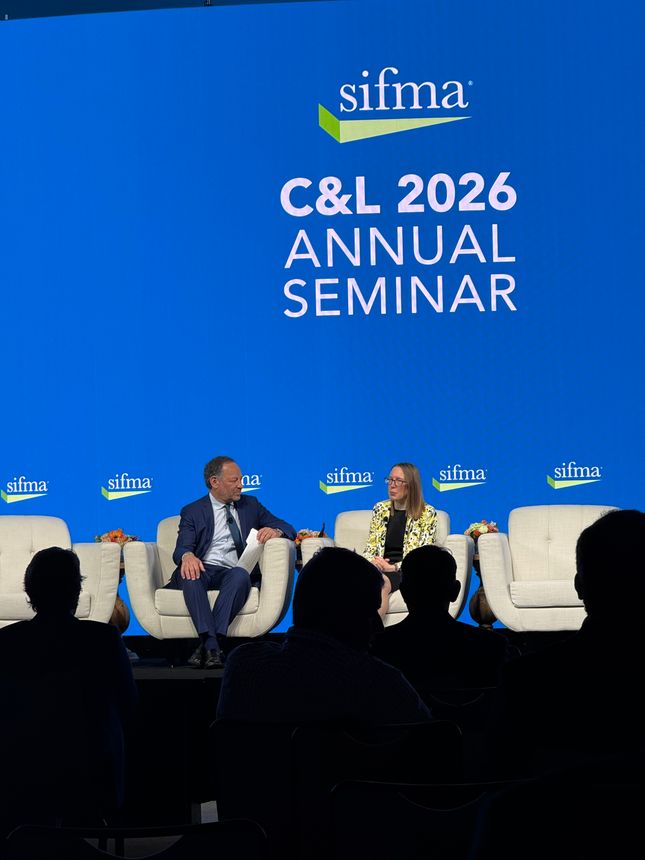

Securities and Exchange Commission (SEC or Commission) Commissioner Hester Peirce delivered wide-ranging remarks at SIFMA's Compliance and Legal 2026 Annual Seminar, addressing the Commission's evolving dynamics, digital assets, artificial intelligence, enforcement priorities under Chairman Paul Atkins, and her vision for a more collaborative regulatory posture.
Commission Dynamics and Bipartisanship
Commissioner Peirce, who has served on the Commission for more than eight years under multiple chairs, was asked whether bipartisan cooperation at the SEC has given way to a more polarized approach. She noted that the Commission's composition is ultimately a matter for the President and the Senate, that there are currently empty seats, including her own, which is "fast on the way to being empty," and that the Commission benefits from a "wide variety of views" and "views that are passionately held."
Chairman Atkins's Agenda and Priorities
Commissioner Peirce acknowledged that Chairman Atkins has a "big agenda" and, while she could not guarantee the entire agenda would be completed, expressed confidence that the Commission is "working extremely hard" and that the public should "expect a lot of it to get done."
Digital Assets and Tokenization
A longstanding advocate for regulatory clarity in the digital asset space, Commissioner Peirce agreed that the regulatory framework is not where it should be, stating that the Commission had "dithered around for so many years" and that progress has been "painfully slow." She criticized the prior approach of bringing "random enforcement actions" as "not a great way of regulating or protecting investors." She said the Commission is now "trying to right the ship and take a more rational approach."
Regarding the pending Clarity Act, Commissioner Peirce said the legislation would be "helpful" and would "provide durability for things that are important," but stressed that the SEC can accomplish a great deal using existing authority, especially when it comes to tokenized traditional equities or fixed income instruments, which fall squarely into the SEC’s traditional jurisdiction. Commissioner Peirce noted that the SEC and the Commodity Futures Trading Commission (CFTC) are working together on these issues and have recently issued joint guidance, and confirmed that the SEC will continue working toward the goal of ensuring a "unified market" while enabling innovation.
New Market Entrants
Asked about risks posed by new entrants that may lack the robust compliance cultures built over decades by incumbents, Commissioner Peirce expressed concern about "any firm" that does not take compliance seriously. No one gets "a pass on compliance," whether incumbent or new entrant, but pushed back on the notion that compliance is the exclusive province of established institutions.
Innovation
She also highlighted the development of an "innovation exemption" framework that would allow market participants to experiment with tokenized securities trading subject to volume limits and investor protections. She emphasized that the SEC's door is open, telling firms to come talk to the SEC to figure out how to do something commercially viable and consistent with the SEC’s statutory mandates.
Artificial Intelligence
Commissioner Peirce expressed optimism about artificial intelligence's (AI) potential to transform both regulation and the financial services industry, noting that AI could allow the SEC to "do more with less" — conducting more comprehensive examinations, identifying problems faster, and becoming a "better regulator.”
On the industry side, she criticized prior rulemaking efforts that took a "suspicious view of using new technology" like AI, stating plainly that "that cannot be the right answer" and that the Commission should "want people to use new technology." However, Commissioner Peirce made clear that firms remain responsible for the actions of their AI agents. Still, she views AI as a net positive that will help firms detect bad actors, identify compliance issues, and operate more efficiently.
Enforcement Priorities
Commissioner Peirce delivered a clear message: the "Enforcement Division is open for business." Chairman Atkins has made it clear that vigorous enforcement of cases involving investor harm is a priority, and she suggested that AI may help the agency address more violations.
However, she did signal a shift in approach, pointing to the off-channel communications enforcement sweep as "an example of what the agency should not be doing on enforcement" and making clear that the SEC is now focused on calibrating when enforcement is the appropriate response versus when an issue is better addressed through the examination process.
Recordkeeping Rules
Commissioner Peirce acknowledged that recordkeeping rules "do need to be looked at" in light of new technology and the growing volume of oral conversations captured in writing. She noted the discrepancy between investment adviser and broker-dealer requirements as worth examining, and that while not a "show stopper agenda item," recordkeeping rules are fundamental to both firms and the SEC doing their jobs effectively.
Waivers and Case Resolution
On waivers and collateral consequences of enforcement settlements, Commissioner Peirce described the current situation as "extremely frustrating," stressing that respondents and their counsel need to know upfront what collateral consequences will follow from a resolution. Addressing this issue does not require a rulemaking, she said, but it is something the Commission is "keenly paying attention to."
/Passle/5fb3c068e5416a1144288bf8/SearchServiceImages/2026-10-12-21-33-47-025-6acd523bc73178b1cd9448b4.jpg)
/Passle/5fb3c068e5416a1144288bf8/SearchServiceImages/2026-10-12-16-37-45-898-6acd0cd93a2af61876051cca.jpg)
/Passle/5fb3c068e5416a1144288bf8/MediaLibrary/Images/2026-10-06-20-06-22-572-6ac554be4e3377a132b4bb3f.png)
/Passle/5fb3c068e5416a1144288bf8/SearchServiceImages/2026-10-01-11-31-16-673-6abe4484864f593e513405f6.jpg)