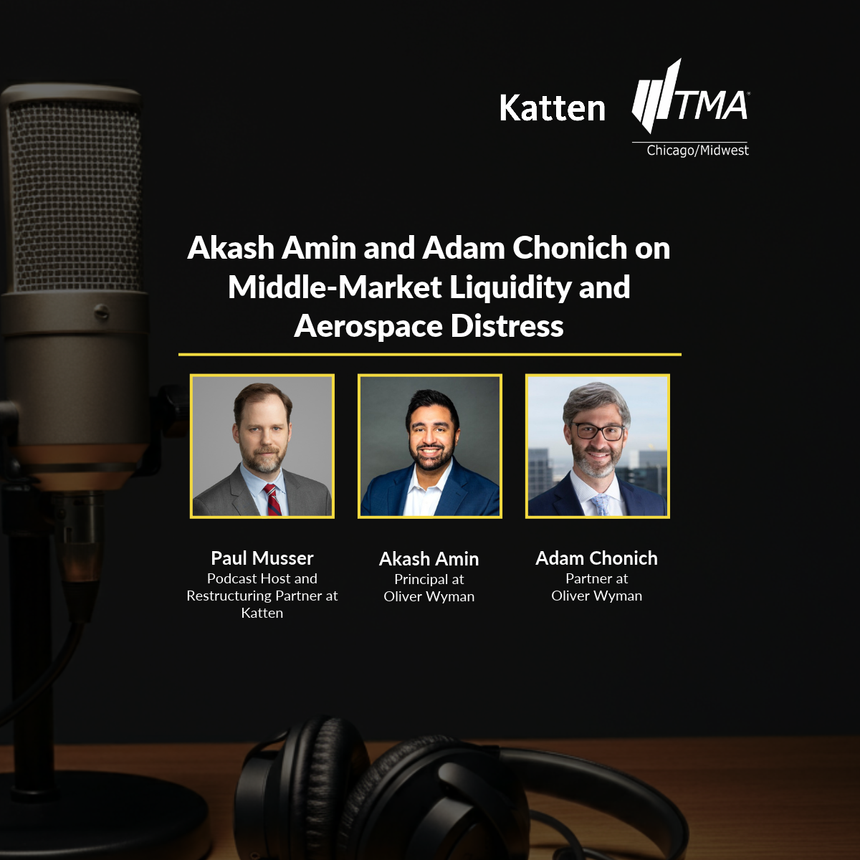
Paul Musser: In this episode of the official podcast of the Turnaround Management Association’s (TMA) Chicago/Midwest chapter, we are honored to have not one, but two guests: Adam Chonich and Akash Amin. Adam is a partner in Oliver Wyman’s finance, risk and restructuring practice in Chicago, where he leads the firm’s working capital and distressed supply chain capabilities globally. He advises companies, lenders and investors through complex operational turnarounds, restructurings and periods of financial stress. Adam has spent the majority of his career representing companies in the automotive and aerospace and defense sectors. Akash is a principal in Oliver Wyman’s finance, risk and restructuring practice in Chicago, supporting middle-market and large-cap turnarounds, transformations and bankruptcies. He has spent the majority of his career representing companies in the food, agricultural and manufacturing sectors, holding executive roles such as chief restructuring officer (CRO) and chief financial officer (CFO). Akash is extremely active in our TMA chapter, where he is currently the vice president of programs. Welcome to the podcast, Adam and Akash. Thank you both for joining me today.
Adam Chonich: Thanks, Paul. It’s a pleasure to be here.
Akash Amin: Thank you, Paul.
Paul: Let’s start where I always start on the podcast. Akash, what led you to a practice in restructuring?
Akash: That’s a great question, Paul. Like many people, I had never really considered a job in restructuring. I cut my teeth in mergers and acquisitions, doing transaction advisory work at Grant Thornton in Houston. When I ultimately moved back home, I was deciding among a lending career, an investment banking career and a consulting career. Then I met the folks at Morris Anderson, where I spent about seven and a half years in turnaround and restructuring before joining CR3, which was later acquired, bringing me to Adam and the Oliver Wyman family. That’s how I made my transition to the restructuring space.
Paul: Adam, what brought you into the restructuring space?
Adam: What brought me into restructuring was a search for something more in finance. I grew up in Detroit, and most of my family worked in the automotive sector, so I saw the industry’s cyclicality and what distress does to the automotive industry in Detroit. I always wanted to do something there and be supportive. Once I realized that audit was not for me, I transitioned to Capstone Advisory Group, which became BRG. I had the opportunity to work on many automotive restructurings, including Chrysler, where we represented Chrysler on behalf of Cerberus initially and then through its bankruptcy. That kept me going through various auto deals over and over again. It was very rewarding because I got to see my cousins, aunts, uncles and other relatives either keep their jobs or see growth in that industry. That’s something I’m very proud of.
Paul: A restructuring that hit close to home.
Adam: Very much.
Paul: Adam, for listeners who aren’t familiar with Oliver Wyman, can you give them some background on the firm, your practice group and the market it covers?
Adam: Absolutely. Oliver Wyman is a global strategy consulting firm. The major industries we spend our time on include automotive, aerospace and defense, various other industrials, and health and life sciences. We’re probably best known for financial services on the strategy side. You don’t see much of our restructuring work in financial services, because that work mostly involves representing banks on big macro acquisitions and transformations. Where we spend our time is on operational transformations, human capital and supply chain strategy. We do a lot of commercial due diligence, operational due diligence and post-acquisition integration work — essentially, how can I make this company bigger and better, even if that requires some type of divestiture?
Paul: Akash, we talked about a couple of the roles you play, but what roles do you often find yourself in individually during a restructuring?
Akash: Having been in the middle market for most of my career, we typically come in as a financial advisor. Historically, I’ve been on the debtor side. We get referred in by the lender, we’re put on a list, we interview with the debtor, and the debtor chooses us, either voluntarily or begrudgingly. That’s how we get our foot in the door. The first job is to build trust. From that trust, we usually do an assessment and let the debtor, as well as the lender, know how severe the situation is. That defines our role going forward. It may be more of a slap on the wrist that the company needs to address. It may need more of an operational manager or interim management. Or it may be an even more dire situation, where a liquidation, a sale or a bankruptcy needs to occur, and we may take on more significant roles, such as CRO or even receiver at times. That middle-market capability is what we’re trying to bring to what Adam and the Oliver Wyman team have historically done with large-scale transformations, along with a skill set and a bench that can tackle bankruptcy situations and more restructurings.
Adam: That’s really what we were looking for in the acquisition of CR3: to build out that bench. When I came over, my charter mandate was continuity-of-supply risk in automotive and aerospace and defense. We were working tirelessly, mostly on aerospace and defense clients, assisting the primes with suppliers that were struggling with working capital constraints, lender constraints and, in some instances, volume constraints. We’ve had issues in that sector where volumes weren’t where vendors expected them to be. I was spending a lot of my time there, left of bankruptcy, leveraging the broader Oliver Wyman toolkit. We were constantly trying to make our way back into traditional restructuring, but you needed scale. You needed CR3. You needed Akash and all the other partners and employees of CR3 to really sink your teeth into a proper insolvency. We got that with the CR3 acquisition.
Paul: To me, it’s often a process-driven exercise, as Akash mentioned at the beginning. You have your steps: you get in there, try to establish trust and take a peek under the hood, and only then do you truly understand what’s needed and what your role will be. And Adam, to your point, having all those different capabilities allows you to serve whatever comes your way, which is only a good thing at the end of the day.
Paul: Corporate mergers and acquisitions are ever-present in today’s economy. Akash, do you have any business development advice for professionals who find themselves going through a merger or acquisition, either internally or externally, when it comes to explaining the development to clients and contacts?
Akash: That’s a great question, Paul, and I’m probably one of the better people to ask, as I’ve had four email addresses in the past 12 months. My former firm, Morris Anderson, was acquired by J.S. Held and is still located in Chicago. Then my next firm, CR3, was acquired. So, I was already in the mode of meeting new people and getting used to a new swing of things, but both transitions were great. I think that speaks to the due diligence firms undertake when acquiring companies. As you said, financial services companies are not immune to this at all; they’re very fruitful targets. I think you’re going to see a lot of activity in this space, whether it’s private equity trying to buy some of these players because of their recurring revenue or, as Adam mentioned, firms seeking scale and a bench to compete on larger bankruptcies and transformation projects.
What my experience has taught me is to be an open learner and stay positive. I’m generally a positive person in what I would call a remarkably pessimistic industry. You have a lot of people who are stressed and upset all the time. But look, we didn’t create the problems; we’re just here to fix them. I’d say stay positive and learn from smart people who have been around the block more than you have. When I wanted to move to a new firm, I always asked, “Who are the leaders I can learn from? Who are the men and women who have done this a lot, whom I can emulate and whose path I can follow, if not carve my own?”
Coming from a much smaller firm to a bigger one, it’s also about utilizing the vast resources available. One of the great things about Oliver Wyman is that it’s part of Marsh, one of the largest insurance companies in the world. There’s a lot of crossover in clientele and skill sets. I swear there is an industry expert on every possible industry niche you could think of here. Having those professionals on our pitch calls, proposals and even engagements adds tremendous value to what we do. I think it’s a great bang for the buck for the client, and it lets us put our best foot forward in everything we do, which is what we all want as professionals. Even if we’re not experts in a space, it’s really nice to have a bench of experts who can help.
Paul: Adam, what are your thoughts on the acquisition, and on going out into the marketplace to explain the new capabilities?
Adam: It’s been great to understand how a very well-respected restructuring firm historically went to market. The way they went to market was very different from how we did. They relied more on lender and law firm relationships, while we relied more on boards of directors and the C-suite, and we’ve been bringing both of those together. To Akash’s point, I can’t stress the value of those industry experts enough. Given how much time I spend in aerospace and defense, it’s important to credential yourself with former executives of large aerospace suppliers and primes and bring them in to help you solve problems. As restructuring experts, as smart as we think we are, and as much as we say we’re jacks-of-all-trades, we’re never as deep as someone who has spent a career, whether in industry or consulting, knowing exactly where to dig.
I’ll use a quick example of a deal I worked on involving an injection molder that I thought was running very well. It looked like it was operating well; there was very little waste on the floor, and it was clean. Then we brought in our plant-floor engineers, and they said, “This whole layout is a mess.” I was just the finance guy looking in and saying, “It looks well organized. Everybody seems to be working.” They told me the throughput was emaciated because of 20 different things. We came in and transformed the plant floor. A true plant-floor transformation isn’t something a restructuring person would otherwise have thought of, but it allowed us to cut costs enough to avoid a formal insolvency filing. That and a few other things helped, but it was a big piece of it. That’s something remarkable you can do when the proper strategy firm complements us restructuring people.
Paul: Absolutely. Before we take a deeper dive into aerospace restructuring, I want to zoom out and get a bigger picture of what you’re seeing in general. Akash, could you give our audience some insight into what you’re seeing at the macro level in the middle market today, especially on the distressed side?
Akash: Of course. It’s an ever-changing business. One thing I’ve been seeing is that liquidity stress is sometimes more important to lenders than accounting profitability when they judge a company’s financial health. I’ve noticed more and more that lenders are not as concerned about operating losses as they are about the strength of the balance sheet and where availability lies within the borrowing base, which Adam will touch on later with his specialty. I’ve found that to be a peculiar situation. Debt structures that worked under different operating assumptions are no longer sustainable or are quite difficult to sustain. In the middle market, that means you have a lot of businesses — not necessarily mom-and-pop shops — that have operated successfully for a long time, sometimes decades.
Now the environment is different, and the existing debt structure that served them for decades no longer fits the current market, whether because of tightening credit terms, margin contraction, longer lead times or, honestly, more competition in the space than ever before. That takes agile, adaptable leaders to turn the page and create a 2.0 version of their company. As we see the transition from baby boomers to the next generation, and there’s already a lot of trouble with succession planning, I feel that — not that people are asleep at the wheel — there’s decision paralysis. I’m seeing a lot of companies not making key decisions or not following through on them. Working capital is a critical battleground, and that’s Adam’s specialty, so he’ll speak to it more.
More situations now require operating solutions, as well as balance sheet solutions. For a long time, companies — primarily in aerospace, middle-market manufacturing and heavy-asset businesses — were able to use the availability on their lines much longer, weather storms, get through hiccups and have cash in the bank, so to speak. When that gets tighter, you need to pull operational levers, and many of them don’t necessarily know how to do that. That’s where firms like Oliver Wyman can help a lot because of our operating presence. We don’t just want to be financial and Excel gurus who make PowerPoints; we like getting our hands dirty. Many of us in this turnaround practice have roots in operational turnaround firms, so we know how to do that and how to scale it. It’s not just Excel junkies anymore. You need to get on the plant floor, know what’s going on and optimize efficiencies that don’t come out of the lender’s pocket. You need to be able to use your own balance sheet and debt vehicles to get out of holes with the assistance of amendments or support, but you have to show you’re doing everything on your end, operationally and financially. Those are some of the middle-market trends I’m seeing, Paul.
Adam: Interest isn’t free anymore. Debt is expensive at this point. As someone who’s currently looking to buy a new house, I’m seeing firsthand how interest rates are affecting decisions. You see that within companies right now. They may have been more willing to let their working capital and cash conversion cycles get out of whack: letting customers pay well outside of terms, paying vendors whatever they want inside of terms and sitting on inventory much longer than they need to. Now they’re looking at things and saying, “This is income I’m losing, because I’m responsible for this cash on my revolver, wherever it might be sitting, which otherwise wouldn’t have needed to be drawn if I were more effective.”
Paul: The other thing I’m seeing is that when the liquidity runway has run out or is about to run out, not only is money more expensive in terms of interest, but lenders’ asks are greater, as they have more and more appetite to do things like appoint independent directors or pull other levers like that. The willingness to simply provide additional funds is much lower, especially if the sponsor of a sponsor-backed company isn’t willing to share that pain as well. So liquidity becomes the paramount concern, as it always has been, but especially today, with money tighter all around. Akash, you mentioned different debt structures, and we’ve talked previously about different approaches for distressed companies. How do these debt structures affect the way distressed companies look at a reorganization, comparing companies that use an asset-based lending (ABL) structure versus a cash flow loan structure?
Akash: Most anyone listening to a podcast like this likely knows the difference between them, but an ABL loan is secured by the company’s assets, primarily inventory and accounts receivable, potentially along with other hard assets. Cash flow loans are underwritten based on the company’s cash flow, profitability and go-forward metrics. In a distressed situation, an ABL lender is going to ask whether there is enough collateral to support the borrowing needs going forward, including supporting a turnaround plan to get the company out of the hole, because it’s going to take some good money to get out of a bad situation. Will that extra liquidity just spin the company’s wheels, or will it generate new liquidity and availability? Will it help create the working capital to get to the next phase of the company? Something I don’t need to dwell on too much before turning to the cash flow side is that it’s not all doom and gloom with distressed companies that lack availability. Sometimes they have a lot of demand and just don’t have the availability, so it will still require some effort to get out of there, whether from them or the lender.
On the cash flow side, the question is whether the borrower can generate enough sustainable cash flow to cover its debt service. That’s always the name of the game on the cash flow side. That’s where I’ve seen, maybe not less patience, but more eagerness from lenders to see a turnaround plan. In my prior roles, I’ve told my partners and colleagues halfway through an assessment, “This isn’t an assessment anymore. This is a turnaround plan, and we need to call the lender right now and let them know.” Otherwise, the company will burn two more weeks of cash, which could be half a million to a million dollars that could be better spent elsewhere. That’s because you don’t necessarily have assets securing the loan. You could have a blanket lien covering everything, but lenders aren’t looking at those assets as closely as ABL lenders, which regularly conduct field exams and appraisals and keep them updated, because that’s their business. That’s how both sides are looking at it.
From my recent experience on the ABL side, it’s about making sure your assets are in order. When things are distressed and, as Adam said, costing more, and your options are more limited, you may find yourself looking at other debt vehicles, such as nonbank ABLs and other loan structures. One client we have right now has more than 60 percent of its revenue tied to inventory held overseas, and most traditional domestic ABLs don’t provide access to that. Even though it may come at a heftier cost, those are underutilized assets in a different geography that I need to vet for my client to make sure we’re getting the best bang for the buck and using the balance sheet in the best way possible. I wouldn’t be surprised to see similar manufacturing companies, or middle-market companies with a global presence, using tactics like this. These are underutilized assets, and they may come at a different price, but the cost of financing from a domestic lender may be something the company can’t afford or doesn’t want to take on at the moment.
Paul: At least in those circumstances, there are assets to leverage to try to bring liquidity in the door with ABL vehicles. In a cash flow situation, it becomes much more difficult to tap cash flow if the cash flow just isn’t there. It’s a much tougher sell to the lenders.
Akash: Exactly. It takes a hard-nosed, executable turnaround plan or turnaround initiatives, whether they include reductions in force (RIFs), divestitures, product rationalization or customer rationalization. Those are things Adam has obviously experienced a lot of, and things CEOs and boards never want to see: “What do you mean you’re going to take away revenue from the company? We need more.” But it’s about making those hard decisions to reach the 2.0, the next stage of the company’s life cycle.
Paul: Let’s pivot to our main topic for today, which is distress in the aerospace industry. Adam, what are you seeing on that front right now?
Adam: I think you’re seeing distress in two different ways. On the commercial side, volumes are coming up, but they’re not necessarily where companies want them to be. Many suppliers, whether tier one or tier two, are still struggling with raw material costs that have increased significantly over the life of their fixed-price contracts, as well as rising labor rates. Then you’re seeing issues on the defense side, where defense is trying to ramp up, and there are working capital gaps when you ask a small tier-one or tier-two supplier to begin buying raw materials to push through that throughput, and they may not have the availability. The challenge is finding ways to support those suppliers, whether they’re burning cash because their contracts are underwater or have limited availability to ramp properly for what defense spending is looking to do.
Paul: We talked earlier about the differences in a turnaround or restructuring involving asset-based lending versus cash flow lending. I read recently that asset-based lending is a foundational pillar of aerospace finance. Can you explain why that is and what’s being used as collateral in most instances?
Adam: If you look at an aerospace company, it’s relying on throughput, so it’s heavily reliant on its receivables, payables and inventory. Having an ABL facility that gives it as much access to capital as possible to buy materials is critical. These companies are so reliant on the initial raw material; the work-in-process stage, which is sometimes very quick and sometimes takes quite a while; and their vendor terms, which are quite long. So it’s about making sure they have the right mix of terms and advance rates in an ABL facility. That’s especially important in an industry where, on the commercial side, you may have 100 or 200 customers but only a few programs your customers are supporting, so you need to make sure a bank doesn’t over-index on limiting availability for a company with heavy program risk.
Paul: Aside from financing, are there other unique challenges practitioners should know about when working on an aerospace workout or restructuring?
Adam: One thing to be thinking about right now is that the original equipment manufacturers (OEMs) are not unsophisticated. The Embraers and Airbuses of the world understand, to a point, that pricing is out of whack, and they’re getting smart about where pricing should be. Recently, you’ve seen a lot of suppliers looking to ramp up the rhetoric and raise pricing with the primes as quickly as they can. They’re getting themselves into situations where they’re unsuccessful in that negotiation and don’t know where to go next. So, it’s really about understanding the right price and why. When you’re going to have a conversation with a customer, do homework that is extremely thorough. Make sure you’ve done the diligence and know exactly what is going on, rather than just putting numbers in front of people and starting to negotiate.
Paul: If forced into a process, what processes are stakeholders often choosing to maximize value or recovery in distressed aerospace deals? Are we talking about bankruptcies, receiverships, out-of-court sales or out-of-court restructurings?
Adam: I think it’s typically out of court at this point. Given the cost of bankruptcies and the amount of time they take, which makes the primes very nervous, spending more time in a bankruptcy, where there’s uncertainty for them, is something they’d like to avoid. They want to spend their capital ensuring that the company ends up someplace that will continue producing parts for them at an agreeable price, so they aren’t worried about continuity-of-supply risk three or six months down the road.
Paul: Akash, what are you seeing in industries outside of aerospace? Are you seeing the same trend away from bankruptcy filings and toward a preference for out-of-court restructurings?
Akash: Yes, I would say that in the middle-market or upper-middle-market, the preference is definitely to work things out of court. You don’t necessarily have the costs and the more rigid timelines of in-court proceedings, or the creditors who can object to certain facets of the process. One interesting point related to what Adam said earlier is what we saw recently with Spirit. Spirit had a plan and was about to emerge and move into the next phase of its life, because there are fewer domestic players and there is a need. It’s a discount carrier in specific markets; Las Vegas and Miami were among its biggest hubs. But something geopolitical, like jet fuel prices, is what I think blew up the model there. Otherwise, you might have seen it survive a bankruptcy. But as Adam knows, working capital and costs are so tight in that industry that something like that blows up the situation, so to speak, and doesn’t leave a viable option. The other players don’t necessarily want to come to the rescue if they don’t have the means to absorb those losses or roll the business into their existing operations.
Paul: Absolutely. There’s the cost factor that I think everybody has to acknowledge: bankruptcies, especially for middle-market companies, are very expensive. Often when you see them filed, it isn’t with a pure reorganization in mind. Typically, it’s with a distressed sale of some sort in mind at the end of the day.
Akash: And Paul, one other thing about bankruptcy in the middle market. Out-of-court is, or can be, a great solution. But as Adam and I know and have used, the Bankruptcy Code and the process can be a very viable tool if used correctly, whether through a Section 363 sale or a liquidating Chapter 11, so to speak, where you can wind the business down in an orderly way, get the best value for your assets, save jobs or at least allow employees to transition with some dignity, and provide referrals to whatever extent you can. You don’t lose as much leverage as you would in a complete fire sale. So it definitely has its advantages, especially when it comes to leases and massive debt. But I think we both agree that out of court is definitely the preference now, with costs rising so much.
Paul: I completely agree. Bankruptcy is a more expensive option that really should be pursued only if there’s a particular advantage the Code will bring you. Let’s say it’s the automatic stay, which you desperately need to get that moment in time to get the house in order or get the sale going. Or it’s the leases you mentioned and the provisions of the Bankruptcy Code in that respect. Or, as I often see, it’s the power of a 363 order and its ability to clear away things you otherwise couldn’t outside of bankruptcy. Short of that, I’m definitely seeing a preference for dealing with these matters out of court, which makes sense. The other part is that when you file for bankruptcy, you’re basically throwing a very sad party to which you’re inviting a lot of different people. With more people come more agendas and more holdup value. You have the uncertainty of the judge, the U.S. Trustee’s office and the addition of a creditors’ committee. It all adds uncertainty, time and expense, all of which is suboptimal.
Adam: When you bring it back to aerospace, the products being produced for the ultimate customer are worth hundreds of millions of dollars, and they rely on a supply chain that isn’t like the automotive supply chain, which is full of very large suppliers. There are still a lot of mom-and-pop shops. Yes, they’re being acquired by private equity, changing hands and slowly becoming bigger, but there are still many very small players that have a profound impact on the supply chain. If a $50 million supplier is a tier-one supplier producing only a week or two in advance, that puts a lot of fear into the eyes of a Boeing or an Airbus: What happens if this isn’t delivered on time? Is it going to slow down my facilities?
Paul: Adam, are there any recent matters in the aerospace industry that our audience should know about, and any particular takeaways from them that listeners should be interested in?
Adam: I think what’s really interesting in the industry right now is how few aerospace bankruptcies you’re seeing. You’re not seeing much of the supply chain filing, but you are seeing a lot of aerospace companies changing hands. Private equity is becoming very aggressive there, and trading multiples are starting to tick up because firms are looking to acquire more. I think many of them prefer defense work to commercial work, but there’s a mix of both. You’re seeing those buyers, whether very large private equity firms or middle-market firms, make decisions about how they’ll respond to the primes on pricing and other issues. In some cases, they’re offloading underperforming divisions after acquisitions rather than negotiating new pricing, selling them to even smaller private equity firms. So, you see a cascading impact, and you end up with a whole group of very small suppliers in desperate need of capital, which makes its way right back to the very large aircraft manufacturers.
Paul: That’s interesting. Let’s pivot to a discussion about TMA and business development. Adam, Oliver Wyman is a sponsor of the TMA Chicago/Midwest chapter. Why has the firm decided to invest in sponsoring our chapter and other chapters throughout the United States?
Adam: TMA is the most valuable resource both for people at Akash’s and my level professionally and for those just being introduced to the market. I really don’t think I would have become the restructuring professional I am, with the relationships I have now, if it weren’t for TMA. I think it’s really important for the next generation to have that access and to know that. I made some of my closest contacts when I was 27 years old, and those contacts are the ones I’m working with today. In aerospace, the people I work with now at the aerospace manufacturers are the ones I met when I was fresh out of grad school, working on my first restructuring cases.
Paul: Akash, can you describe your TMA journey? You’ve been involved in our chapter for a long time in a variety of roles. How did you first become involved in TMA? Tell the audience about your path and any advice you have for others looking to grow within the organization.
Akash: Definitely, Paul. I mirror a lot of what Adam said, and TMA is near and dear to my heart. I, too, joined at 27, when I entered the restructuring industry, at the recommendation of my bosses at my first restructuring firm. I joined the NextGen committee and started going to events. It can be quite daunting. The NextGen committee was great when I was starting out, because I could get my feet wet and meet others in similar age groups who were going through the same trials and tribulations I was. We could vent, commiserate and talk about the cool cases, the boring cases or wherever we were traveling. You can learn a lot without being embarrassed, which can sometimes happen when you walk into rooms with very high-level, intelligent and successful individuals. It was great to have a less daunting way to join these events.
I then became chair of the NextGen committee for a few years, which was very cool. I met some great peers whom I now consider friends; some even came to my wedding. We created some great events, like the fall golf outing and the Bulls game, and I’m glad to see those have continued. Then I moved to the entertainment committee, where I was co-chair and oversaw the move of Martini Night from Gibsons to RPM, which I think has been successful, and now to the casino tables, which has been a big hit and a nice change of flavor. Adam and I are big fans of golf, so the annual golf event was always really fun and something I looked forward to. I still can’t beat the Bruton Highland courses; they have my number every time I’m out there. Becoming VP of programs was a great but challenging experience, as I’ve been responsible for picking the Executive Speaker Forum speaker, who I’m very happy to say is Alex Rodriguez this year, and overseeing some of our main events. It’s been a great experience.
I’ve made so many connections through TMA who have fed me deals and whom I can just pick up the phone and call about different situations. I can’t say enough great things about TMA. My advice for others looking to grow in TMA is to sign up and get involved. Everyone’s willing to help. Join a committee and ask around — ask me, ask Paul, ask Adam and others — about what you can do to get involved. I’m encouraging our younger associates and staff to join these committees and meet people. Go grab coffee, lunch or dinner. You’d be surprised how far it can take you. It’s not just that first connection; it’s the second-, third- and fourth-level connections that really grow your network and make you dangerous. That’s been the greatest reward, along with enjoying these events: how much TMA has added to my career and development.
Adam: I think the point you made, Akash, about just going for it is important. Everybody feels anxiety walking into a networking event. You wonder, “Does everybody here know everybody else?” and you feel uncomfortable. But that’s everyone. Once I learned that, I realized that everybody really just wants someone else to come up and talk to them, because they’re too nervous to do it themselves. It’s a great environment to develop truly meaningful relationships that may not pay off tomorrow — and they shouldn’t, because it takes time to develop real friendships. But they’ll pay off over time if you stick with it and invest for the long term.
Paul: I would say that both TMA and restructuring in general make up a fairly small community, but also a fairly friendly one. We all deal with very difficult situations, and we often occupy different chairs — sometimes adjacent, sometimes directly across the table. But for the most part, we all work well together to try to get a good overall result, and I feel that’s how people play in the sandbox together at TMA. People are friendly; they’re happy to make introductions and grab coffee. They want to see people participate on committees, speak up and share their opinions. It’s a friendly and forgiving environment, especially when you’re first starting out and entering the world of developing business beyond just doing the work. That’s an interesting pivot we all have to make at some point. We’ve all studied and been geared toward doing a great job on the work we have, and that’s obviously paramount. But there comes a time when you have to think long term.
It’s not just about doing the work; at some point, you also have to win the work. Adam, you mentioned that it doesn’t happen overnight. You have to plant seeds, and it takes years to develop. But the sooner you start that process, the better. Akash, you mentioned the NextGen committee. That’s a great way to do it, because those people are taking the same path you are. Their careers are advancing in the same or similar ways, so they’ll reach those heights at the same time, and they’ll become great referral sources. You can look back and say, “Remember when, before all this, we were starting out and working on that committee, or doing this work before it was paid work?” Those are great, authentic connections you’ll have with people who become decision-makers.
Adam: We still talk about a hockey game with a few of my friends from the former Kaye Scholer, now Arnold & Porter, Hyper AMS and Capstone. We still tell the same story about a very specific hockey game from a long time ago, when we were in our 20s. I’m no longer in my 20s, and I look back on it fondly.
Paul: Akash, the last question I’ll ask today is whether you have any broader business development tips or advice to share with our audience. We talked a little about people who are starting out, but this is for anyone in the restructuring space.
Akash: I was very grateful early in my career to be encouraged by my bosses to go out, meet people and develop my network. As Adam said, you need to develop your network at a younger age, and you can’t be afraid to go out there. You’d be surprised how fruitful those relationships can be over time. It won’t happen overnight; it takes years. You also need to develop your own skill set at the same time. The tips I would offer are to have regular, frequent touchpoints. Something that has worked for me, as a consultant like Adam, is recognizing that the relationship can feel transactional, and people may think you’re just trying to get leads, engagements and referrals. What I always like to do, and what we can do if we’re good at it, is to see how I can help the person across the table. Is there someone I can introduce you to? Is there a dinner we can put together with a variety of people — maybe a workout lender, an attorney, a consultant, a private equity professional and an investment banker? That way, we can all learn a little at the same time and develop our own networks with the same group.
As much as I’d like to get some work, I want to help the other person, too, because I think they’ll remember me more fondly that way. I would also say listening is extremely important, and it’s something I’ve had to work on in my career. You shouldn’t talk at someone; you should listen. If you take an interest in people’s lives and don’t make it all about work, I think you’ll be remembered better and in a better light. You don’t want to be just a transactional person. You want to be a person who happens to work in the restructuring industry. For whatever reason, all three of us are crazy enough to work in this industry and enjoy it, and there are few of us. As Paul said, it’s a small community, so you already have that one bonding connection. See what other connections you can make; you’d be surprised how people open up. Ultimately, people want to work with people they like and trust. I think that’s the key to getting leads on work and then winning the work, which is what you’re trying to do.
Paul: Adam, any thoughts?
Adam: I think Akash covered it really well. This is a network in a small industry, and long-term, meaningful friendships that go beyond the transactional are critical. An association like TMA allows you to build those relationships in a very safe, disarming way.
Paul: Thanks so much for joining me on the podcast today, Adam and Akash.
Adam and Akash: Thank you, Paul.
Paul: Our guests for today were Adam Chonich and Akash Amin from Oliver Wyman. I’m Paul Musser. Thank you, listeners, for tuning in. This has been an episode of the TMA Chicago/Midwest Podcast.