



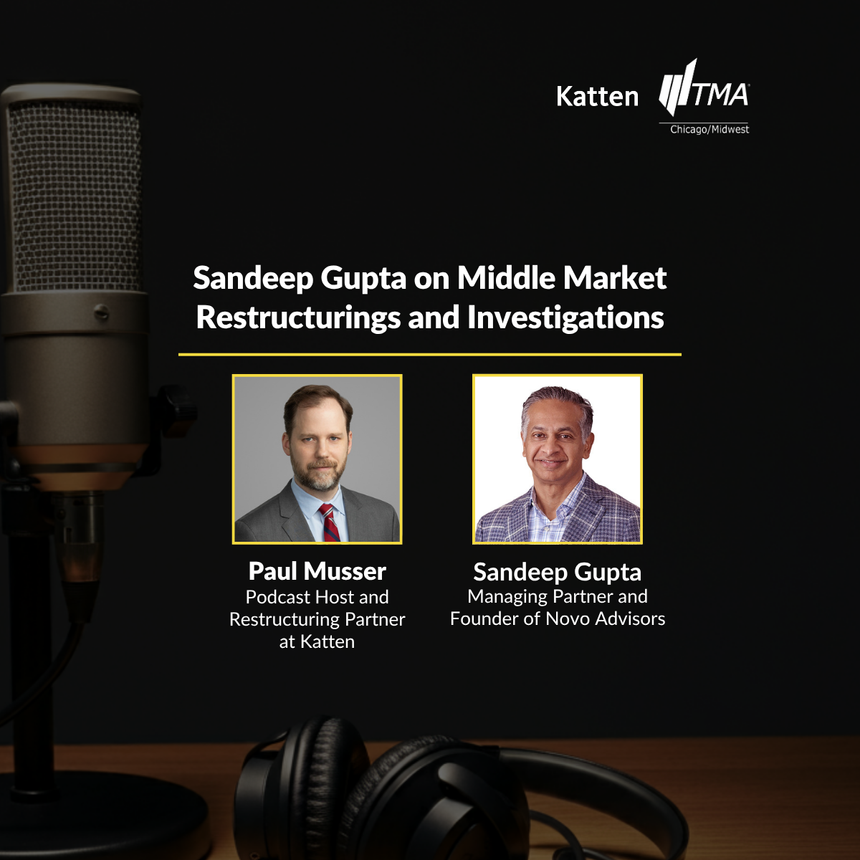
In the latest episode of the TMA Chicago/Midwest Podcast, I sat down with Novo Advisors Managing Partner and Founder Sandeep Gupta. We discussed Sandeep’s “accidental” arrival into restructuring, his entrepreneurial mindset and its influence on his turnaround and restructuring work, the nuances of working with closely held, family-owned businesses versus private-equity sponsored companies, strategies and techniques for middle market restructurings and private credit workouts, and the firm’s recently launched forensic and dispute advisory service line. Then, we both share insights into middle market fraud investigations and discuss the importance of relationship-building within the industry.
Paul Musser: Hello, and welcome to the TMA Chicago/Midwest (TMA) Podcast. I'm your host, Paul Musser, a partner in the Restructuring group at Katten in Chicago. In this episode of the official podcast of the Turnaround Management Association's Chicago/Midwest Chapter, we have with us Sandeep Gupta. Sandeep has over three decades of experience in executing turnarounds and restructurings, as well as financial advisory and operational improvement.
After honing his financial and turnaround skills at FTI Consulting, Silverman Consulting and Arthur D. Little, Sandeep founded Novo Advisors (Novo) in 2012, where he serves as managing partner. While at Novo Advisors, Sandeep has taken on several notable interim management and fiduciary services roles in a diverse range of industries that include technology, specialty finance, healthcare, agriculture and automotive.
Welcome to the podcast, Sandy. Thanks for joining me today.
Sandeep Gupta: Thanks for having me, Paul.
Paul: I always like to start with the question of: why restructuring? What led you to a practice in restructuring? And before you give your answer, I'd like to note for the audience that you started off as an engineer in the nuclear power industry. So, there were bound to be some twists and turns before you landed on a career in restructuring.
Sandeep: Yeah, honestly, Paul, it was just an accident. 1999 … those of us who remember 1999 … remember that that was the era of everyone wanting to do dot-com/telecom consulting, was super exciting at the time. There's all kinds of things that were going on. And I was looking for something to do that was different than what I had come out of business school doing. I found all kinds of opportunities that offered to do work for dot-coms/telecom consulting. And then I had one offer to do turnaround consulting with Silverman Consulting. And for me, I like to get out of bed every morning. I like to work hard. I want to be excited to go to work. And of all the offers I had at the time, that was the most exciting to me. So that's kind of how I stumbled into becoming a turnaround consultant.
Paul: For our listeners that aren't as familiar with Novo Advisors, can you give them some background on the firm and what it does in the market that you cover?
Sandeep: Yeah, happy to. So, in 2012, I started Novo Advisors and I had a wonderful career, as you touched on. I was at FTI before that and enjoyed my time there very much, but I found myself kind of getting away from the core middle market, which is what Novo focuses on. You know, middle markets are a pretty broad term, but I think businesses that are somewhere in the $150 to $500 million top line are what we like to work on.
I like that segment versus something that's larger. You know, once you get past a billion, then we would probably take pause and think about the engagement because in these-sized businesses, they have some scale, and with our operational prowess, we can actually jump in and find opportunities to improve performance. Butm you can also get your arms around the business. If you get much larger than that, those that size, scale is much more difficult for us to just understand. And so we like that segment overall, so that's the primary focus of NOVO Advisors.
Outside of that, I just think that it's super fun when we get into opportunities. You know, oftentimes they tend to be stressed/distressed. And if you jump into a business that has some degree of scale before everyone's so quick to want to jump to a Chapter 11 process, we don't want to do that. We want to avoid that. And when you have that level of operational leverage, you can probably find an opportunity to help businesses without putting them into a filing or restructuring or anything like that.
Paul: So, as an entrepreneur and as somebody who started Novo Advisors, does that spirit of entrepreneurship affect your work with distressed companies?
Sandeep: It does tremendously. The way I think about it is running a distressed business, or getting involved in a distressed business, isn't dissimilar to a startup because you're kind of taking pause, taking a step back, trying to rethink what that business model might be, what the future might be. I find it super constructive to just sort of put my entrepreneurial hat on and say, well, what's the art of possible? And oftentimes, as professionals, we've heard our clients say, well, it's been like that for a long time. That'll never work. We've been told “no” so many times. I think that a fresh set of eyes and just a creative perspective in a situation really lends itself to opportunities for improvement. So, a lot of parallels between turnaround and entrepreneurship.
Paul: Yeah, I find that to be particularly the case on the company side. When I do lender engagements, typically you're working with special assets folks who have seen this over and over and over again. So, they're well familiar with the steps that need to happen with distressed loans and distressed businesses. But when you're dealing on the company side, the initial phase is almost more psychological. It's almost walking people through what might be in store for them. This is usually their first time. And then I would think, being an entrepreneur yourself, you can sort of relate to the processes that they're going through with their business baby, the next steps and the emotional response that almost needs to be overcome at the business in any kind of turnaround.
Sandeep: It really does. It's very true for closely held single shareholder type situations, where oftentimes some of our clients tend to be second or third generation, sometimes first generation. And it's not that they're bad operators, but something may have shifted in the marketplace that they service. And so, I think a lot of times a management team that's in a situation like that, they're stuck, and while it's always been like that, we hope that things will return back. And I think us getting involved just puts them in a position where we can ask the question thoughtfully without being overly burdensome and saying, “Hey, listen, we've seen that in the data or the analysis or whatever we're looking at that point in time, we've seen this sort of shift. Tell us about that. Tell us what's going on.”
And that fosters a conversation where you can start talking about a pivot or some sort of adjustment in how they think about their business. So, absolutely.
Paul: Yeah, I would imagine that's a different approach than when you're dealing with those that are sponsor-backed or sponsor-driven, where it tends to be a little bit more analytical or data-driven.
Sandeep: It is very different because 1.) it's more personal. So, for us … not just myself, but my colleagues … also have adopted the entrepreneurial spirit here. I mean, we treat Novo Advisors as our own business. We treat our clients as our own business. And so, it's a huge difference. Whereas when you get into a private equity back situation, I would say the fundamental differences for a sponsor is just business, because they too are financiers and they have to make a business decision. Their livelihood or future isn't necessarily tied to the business. However, that said, the management teams are very much entrepreneurs too. Not in the strictest sense because it's not necessarily that they put their entire livelihood or life savings at stake, but they are incentivized to take risks. Their incentives are aligned to grow the business or improve the performance. And sometimes, whether they meant to or not, sometimes you make a strategic misstep. You have to rethink how you thought about that approach or that opportunity. And just like we do with closely held businesses in a sponsor-backed situation, we would have the same approach. “Well, tell us what's going on. How did this sort of go off the rails? How do we think about getting this back on track?” And we have that same conversation. The best outcome would be us taking a step back, getting the management team to realign with what we've observed then agreeing to it, and then the sponsors, the lenders, everybody sort of aligning on, “Okay, that's the pivot, and let's get back on track.”
Paul: Yeah, I think the other part of that too are really then the relationships that are at issue between the lenders and the borrowers in that case. Sometimes I find on the bank side, there can be tight relationships involving closely held businesses that are very, very personal, right? That helps to guide everyone through the turnaround. And then on the sponsor side, I find that sometimes those relationships are more business relationships. Like this is one of 10, or one of eight different loans that the parties have between each other. And oftentimes, leaning on those relationships can help everyone get to the best outcome possible. And really, for professionals, I think sometimes we need to consider those as a part of that process and make sure that we maintain them in respect
Sandeep: Yeah, just to add to that … today more than ever, I think we need to understand those relationships and respect them more because private equity is pretty, pretty big. I mean, 30 years ago, when I got into the business, private equity wasn't as prevalent as it is today. And then we got private credit in addition to that, and in addition to the lending commercial banks. So the relationships and all of this, they mean more today than they ever have in any situation. I completely agree with that.
Paul: Well, let's pivot over to a quick discussion of where you're seeing things in the private credit workout field right now. As you mentioned, private credit, in general, is an area that's generating a lot of headlines right now. Can you give our audience an overview of what you're seeing in the private credit workout space currently?
Sandeep: In the matters that we're involved with, which include private credit, private credit is an interesting asset class because they're not afraid of a difficult situation, in so much as they are happy to catch the keys of the sponsor. They, generally speaking, are sponsor-backed. If the sponsor is done supporting the company, they will catch the keys. They will have us get involved to develop a turnaround plan or repositioning of the business, whatever the situation may dictate. And they will then actively work on installing an independent board. And our playbook, as we're fleshing this out, is for us to stabilize the business and then help the private credit team or the board recruit new management to take the keys and realign the business. You gotta thread the needle carefully in these situations because there's a little bit of a trade-off, because the way I think about it is: us as restructuring operators, we know how to reposition the business to get it back on track. But I don't, and we can run the business, but I think it's more economic and it makes more sense to have an incumbent or a new management team jump in and take the keys and run with it. For a lot of reasons, it just makes a lot of sense.
Paul: Can you talk about some of the diligence that Novo often finds itself doing to help private credit lenders determine their workout strategy, and the rights and remedies that they are considering as a part of it?
Sandeep: Yeah, rights and remedies is a good question. I think in the beginning part of a situation, generally speaking, we get involved on the company side. 80 percent of what we do is company-side work. And so, when we talk about rights and remedies, oftentimes, we encourage the private credit lenders to have a dialogue with the sponsor and the board to just see where they're at and really get to a point where, “Are you in or not in?” And get to that sooner rather than later. It's not unusual for people to be in disagreement and there's always some sort of a scuffle that's going on in the background. And for us, the things we take a lot of pride in is just get the business backs, right? Put down … and we want to move very quickly within 30 to 45 days, obviously … 13-week cashflow forecast … we all as professionals know what that is, right? But we also want to solve for a break-even point, we also want to solve for here's what's going on with the working capital … all those things are essential, because even though the parties may have a fundamental disagreement on the next step, the business facts will tell you “Well, here's what's going on here, so if we're going to support this, whatever you just said, does it align with what this these business facts are telling us?”
And that usually gets the conversation going, so that's usually our first step. Second part of your question is, how do we advise or guide a situation that's private credit-backed? We'll solve for it: “Okay, here's what the next 12 months look like in the current state. Here's where we see low-hanging fruit.” If we execute on, say, a head count reduction or … let's just say you want to rationalize the SKU base or the customer base to manage working capital because that's your constraint. We'll provide that advice and then ultimately solve for, “Well, here's the incremental capital that the situation is going to need over the next 12 or 18 months.” And you put that number in front of the private credit folks and ask them, “Look, is this something that you have the appetite to support? Usually, they do in the instances we've been involved with. We've never had a private credit say no, we're not going to support that. And if they don't want to support it, we always say, “Look, if you have the appetite, great. And if not, then let's start doing some diligence with investment bankers and let's put this business up for sale, and you can take your chips off.” So far, the private credit folks have been supportive about moving forward with us and the diligence that we provide to them.
Paul: Let's move on to our next topic of the day. Novo has recently launched an official forensic and dispute advisory service line. I'd love to dig into this type of work with you as a part of our conversation. Just at a high level, what are forensic and dispute advisory services?
Sandeep: Yeah, I mean, in many of the situations that we get involved with … not many, but I'd say about half … there's always some sort of a dispute as to whether a certain player was on the up and up, or was legitimate. There's some question as to whether they had integrity or … I'll stop short of malfeasance. And so, yeah, unfortunately, we do run into those sorts of situations, too. And so, we always want to sort of nip that in the bud, if you will, to the extent that it's a little bit of hearsay. At our general consulting bench, we’ll be able to dig into certain questions or concerns and address those.
But, when Claudia Springer, one of our colleagues, joined the team about four or five years ago (and for those who don't know Claudia, she became an FA after practicing law for 41 years), she brought to us this dispute resolution concept. And because she's a lawyer and, more recently with Kate Latner joining the team and leading the endeavor, it just became a natural extension of the services that we offer. We have the core turnaround and restructuring stuff, but to the extent we need to diligence or support for a forensics or fraud investigation, we have the ability to do that.
And I'll also say, as we've built Novo, we haven't necessarily built it with the thought that we expect disputes, and in this case, disputes forensics to become more of a workstream going forward or more demand for those services. We just hire good people, and we take it from there. But I will tell you, given what's going on, and I think we all read the headlines and understand what's going on in private credit, private equity and just the markets in general … I would expect the demand for that to increase and be at pretty high demand over the next three to four years, just because as people take pause and start re-evaluating their investments, they're going to find problems like that. And that's in addition to all the things we hear about crypto and all those, what I call idiosyncratic and sort of “out there,” that's always there. But even in the core business universe, you're going to see more opportunities for, and need for, support.
Paul: Yeah, to me, it's sort of like, look, when loans go into default, there's always a little bit of an investigation as to why it happened. And a lot of times it's for business reasons or industry reasons, or general economic reasons. But then, to your point from earlier, there becomes this kind of gray area where the dealing is sort of shady, where we are talking about actual fraud. Sometimes I've discussed it with clients as, you know, is it capital “F” fraud as in legal fraud, or is it maybe a lowercase “f” as in, you know, something sort of around the edges that nobody feels that great about. And as a result, I mean, are there claims or things that need to be done about it? And those cases for me tend to be the hairiest and the longest. And I'm sure you're seeing that same type of thing.
So, if you could give our audience some typical scenarios where clients approach you for these types of services, without naming names or their stories? Or examples from your experience that you could share to give our audience a sense of what those types of engagements look like in your practice.
Sandeep: Yeah, happy to. So, if you look at the Epic case that we were just involved with recently, Claudia Springer (again, she was a Chapter 11 trustee of that) … And just a quick snapshot on that: there was a lot of stuff going on there. But the biggest challenge that we found in that instance was that approximately $550 million dollars went missing. The company founders and owners had borrowed about $1.5 billion from a bunch of lenders. And one day, overnight, $550 million went away.
Paul: What's a half a billion dollars between friends, right?
Sandeep: Yeah, exactly. And so, there's a lot of things that sort of cascaded as a result of that action. You know, the company ended up in a bankruptcy filing. We became the Chapter 11 trustee. And now, as a Chapter 11 trustee, we got to figure out what to do. I mean, part of our work stream was standing up the businesses that were involved and just sort of putting them back on track. But then we had to figure out how to start tracing some of the funds, or at least make an attempt to start tracing where all the funds went. And in that instance, because it was a very large fraud and it was international, it made a lot of sense for us to ask FTI to help us with that. And they were happy to do so because I know the folks there quite well, having worked there before. But, I mean, that's just a case in point where it doesn't necessarily have to be international. Monies do disappear. We do live in a very small global economy now. It's become smaller in my career. And so, that's probably an extreme example because of the amount and the international scale of that business, but we're seeing stuff like that all the time. When we saw that happening, we were involved in that a year later, it made sense for us to say, “Hey, it's time to pivot and stand up this group.”
Paul: Sure. When we talked in advance of the podcast, you mentioned that the middle market doesn't often have the appetite to pursue these types of investigations, typically due to cost and recovery. Can you talk about these challenges and concerns, and how you try to address them at Novo with your middle-market investigations?
Sandeep: Yeah, it's always a challenge because lenders who tend to be the stakeholders at the end, they're fatigued. They are frustrated. They're fatigued. They're like, well, let's put this behind us. We're involved in another matter right now where we're the Chapter 7 trustee of that case. It was an ATM business, and we told the lenders in that instance, “Look, we don't know if we can recover anything. You don't know if you can recover anything. Give us a budget. Let's give us $100,000 to work with. Let's see what we learn in our $100,000. Once we come back with our findings, if it makes sense to continue, then we'll continue. And if it doesn't make sense, then we're done.” At least then you've kind of boxed in the exposure and the thought. And that's how we proceeded. We got done with our initial investigation there. And then they said, “ Yeah, let's keep going for a bit more.” So, they gave us another $100,000. At least that way, you're kind of thoughtfully addressing it. And they feel like, hey, at least we made a little bit of an effort for some recovery. And if it works, great, and if it doesn't, we're still fleshing all this stuff out. But eventually, what I would expect would happen is probably 50/50. 50 percent of the time, you're going to see there's an opportunity for recovery, and you keep going. And half the time they'll be like, “Okay, we're done.”
Paul: Yeah, that focus on recovery, especially on the lender side engagements, is so important. These fraud cases, if you run everything down, I mean, you're talking years. I have one that I wrapped up recently where we were going at it for seven to eight years, and it resulted in a criminal conviction at the end of the day. And I think it's important to really talk to those clients at the beginning, especially when they first discover or have inclinations of the fraud, and say, “I completely understand how angry you are, and I'm angry for you, and it's outrageous, essentially, what happened to you. I, as an attorney, I can go and light these people on fire if you want me to, and that'll make you feel good for a little bit. But we also need to take a step back and think about ‘are there assets here to recover?’” You know, what makes the most sense from just the dollars and cents perspective going forward? And maybe it is that sort of scorched-earth approach, especially at the beginning. But as we go and we move on, we need to sometimes recalibrate and really think about: what are the assets that we're bringing in? How are we monetizing them? What type of return are we getting? Because that really is what's economically most important at the end.
Sandeep: Exactly, exactly. And just to add to that, but part of it's also that people have a business to run, right? They have other files to deal with. They have other matters. They have an organization. I mean, we have to be sensible and say, “Hey, is there a potential path for recovery here? Otherwise, put your energy into something else.” Again, these are just practical approaches to these situations.
Paul: No, that's a great point because again, these files can take on a life of their own and they really can be all consuming at the end of the day. Because usually, there are plenty of rocks to look under and you really do have to think about what's the best use of your time as well as your money. So, what are the red flags that you're looking for at the start of these engagements? And then when you discover them, what are the immediate steps that you advise the client to put in place to try to at least minimize as much of the damage as they can going forward?
Sandeep: Yeah, great question. When we've discovered fraud in a situation, we don't start the engagement that way. We start the engagement with “Hey, I'm here to help you. Let's figure out how we can help. Let's figure out how to work together.” I'll give you an example of where it became apparent that there was a problem. We were involved in a commercial cleaning business called Kimco Services. We got involved in it in the fall of 2016. And we're trying to get our arms around the numbers as our typical process is. First five or six weeks, we take a deep dive, and we're just trying to build a cash flow forecast. And the numbers just weren't coming together. And we kept kind of scratching our heads saying, “What's going on here?”
And invariably, what happens is through our process, when we start monitoring cash flows and actual performance of cash against the budget that we've created, you're going to start to see things move around a little bit. And when you start talking to the financial team there … in this case, it was the CFO … he'll say one thing one day, then he said something else the next day. And invariably, after about four or five weeks, eight weeks, I can't remember now … we finally figured out that this guy was siphoning off funds to deal with other liabilities and issues that he and his co-owners had created in a prior life. And so, as we started sort of sifting through that, we built a case, and after we explained everything to the stakeholders, confronted him and said, “Hey, you said this, but that's not what this says.” And he'd come up with an answer. Then we'd have another example. “You said this, but that's not what this says.” And after four or five examples like that, he more or less raised his hand and said, “Okay, you caught me in this.” But I mean, it's sort of one of those things when you ask the question of red flags. I don't know if anybody ever thinks of it that way. Maybe out of a bankruptcy case, you might have some litigation that needs to be supported, which is a little bit different. But for us, you know, we're just your simple turnaround consultant here to help. And the story unfolds from there.
Paul: Yeah, I think that's correct. When I think about the two largest fraud cases that I dealt with, they didn't come to us originally as fraud cases. One of them was going to be a series of commercial foreclosures. And then, as we did some investigation and we did our due diligence and we did a collateral review and we started some of the cases, we discovered that the principal had discovered his own mortality and decided that for an estate planning purpose, he would ship assets off to the Cook Islands. So that wasn't something where, when we were engaged, anybody thought they were funny business. They just thought it was a series of foreclosures that we were going to deal with. And it turned into a massive real estate fraud that ended up with numerous judgments and then a bankruptcy, and what have you. And the other one was the same way, which was a borrowing-based certificate fraud where we were looking at the documents, and over time, it became clear that was fraud on several levels. So, I think having that service within your larger service really does make a lot of sense because it will be something, unfortunately, that you have to tap into from time to time. I think it's a wonderful carrot or stick or whatever you want to use that you have now at your disposal that you can offer folks.
Sandeep: I appreciate you saying that. We're excited to have it. We're excited to have Kate. You know, she's very well respected in the industry. So, we're excited to have her have her here and lead the practice.
Paul: Let's pivot into a discussion then about TMA and just business development in general. Novo Advisors is a sponsor of our chapter. You've been a long-time member and very active in the chapter as well. Why has Novo, and why have you, decided to invest so much of your time into our TMA chapter and in TMA in general?
Sandeep: Look, for me, going back to how I got into turnaround consulting and where I am today … if you had asked me 30 years ago and said this was going to be your career, I would have been like, okay, maybe, right? If you had said to me at that point in time, “Hey, by the way, you're going to be a rainmaker. You're going to be a business developer. You're going to have your own firm” … I would have kind of chuckled and said, there's just no way. I was just glad to have a job and have fun doing what I was doing.
So, why do I give back to the TMA? It's been such a wonderful career. Whether we're on the same side of the table or we're on other sides of the table, I think generally speaking, we play in the sandbox very well together as a community, as a bunch of professionals. I think that people in our industry are super smart. They're very accomplished. I love the fact that every day I wake up, I learn something new about an industry, about a situation, about the law. I'm not a lawyer. I love that. And for that reason, I had the good fortune along the way of having really good mentors mentor me. And I think, by giving back to the TMA, it positions the organization to give back to the young professionals that are up and coming, certainly to our peers. But philosophically, as a firm, we believe that we should support our peer groups. And that's why we're so entrenched in TMA and are glad to do it.
Paul: Yeah, I definitely take your point, especially about the size of the restructuring community. I mean, nationwide, Chicago-wide, it's still very small. You bump into the same people all the time. And it really does behoove you to have a good reputation and to have a positive interaction with these people. And I do marvel sometimes at the fact that we find ourselves in extremely stressful/distressed situations, but I find that most of the time, people are very collegial and that they're working to solve the problem together. Maybe not when fraud is involved, like we were talking about before, but in our non-fraudulent situations, usually folks are trying to find a path that will make it work as best they can for the different stakeholders that are at issue.
Sandeep: Yeah, we really do band together and again, you may be representing a lender in a matter where I'm representing the company and through counsel … we figure out how to work together to come up with solutions that are good for everybody. And I'll tell you something else, Paul, that I will say with such humility … As I built Novo Advisors, but even before that in general, people are very nice. Whenever I reach out to folks and I say, “Can I have 30?” Somebody new that I haven't met yet or had the opportunity to meet … when I reach out, whether it's in Chicago or anywhere else in the country … generally speaking, people respond and say, ‘Sure, I'll give you 30 minutes of my time.” That's the industry that we live in, that we play in. And I am so humbled by that because people don't need to do that for us. And I do the same for others just because I think, again, I'm at a different point in my career where we need to make that investment for the future. So, I appreciate that.
Paul: So, even thinking more broadly about business development, as somebody who is a founder of Novo Advisors and has built this very successful practice, what advice or tips can you share with our audience, particularly for those folks that are looking to either grow their practices and/or are closer to the beginning of their journey?
Sandeep: I'll tell you how I started and how people should connect themselves. When I got in the business, I'd go to events, and like anybody else, I'm just a kid. I don't know what I'm doing, right? But, as I was going to the cocktail parties or happy hours, and whether it's at TMA or whatever, I made a rule for myself. I'd come home with two business cards … something that was achievable, not over the top. I kind of stuck to my rule there. And just over time, I got to know a lot of people that way.
The second thing I would advise everybody, and this is what I tell everybody at Novo: do good work. If you do really good work on that deal that you were on, people will recognize that and you'll at least have the reputation. You said it very well. And they'll think of you when the next matter comes up. Now, it won't happen overnight … it honestly takes a person a decade, if not longer, to build that momentum and to be a salesperson or business development type of person. But if you do good work and you're reputable, people will start to think of you because they'll start to see you over and over again in various matters.
And the third thing I would say is that once you have built some momentum, you really need to have a consistent marketing effort going on in the background. Still, work matters. I'm still very busy helping clients out, along with my peers and my colleagues here. But I will always every week, have something going on on the business development front, whether it's a Zoom or a Teams call. It could be a lunch, breakfast, cocktails, whatever it takes. But every week, you need to have something going on.
And somebody said this to me a long time ago … if you wait until your matter's done and you have time to market, it's probably too late. So, you got to have some momentum. It's hard because you're trying to shoehorn a 30-minute call in when you're dealing with a crisis situation. You just got to do it.
Paul: Yeah, you got to keep that pipeline going, right? You don't want to have to go back to it after it's dry. And I mean, that last bit of advice really is important. It's so easy to … suck in isn't the right term … but essentially, there's always work to do. And usually what you're dealing with is an emergency of some kind, but to really prioritize that consistent development so that it's there as opposed to, you know, it's there when you're done with the last engagement. That's really, really important. So, I think that's some great advice, Sandeep. And it's really, really important for all professionals of all kinds in our space. I also love the first part that you mentioned about having goals, which are just small and attainable that you can check off, even just from a psychological perspective, to just say, “Look, I'm gonna go here. I'm gonna get a card or two. And that's going to be my win for the day. All I have to do is meet one or two people, and that's fine. And over time, if I do that, I will accumulate my network over time. I don't need to make it all happen at this one conference or this one meeting. I can just take those baby steps as long as I make sure I'm doing them consistently over time.” It's really great advice.
Sandeep: Yeah. And I'll tell you the one thing, there's a woman I worked with at FTI who said this to me, and I didn't think about it until she said it, but she was spot on: it'll take you at least a decade to have something that you can hang your hat on at least, right? Probably depends on your age and where you are in your career. And, you know, part of it's a function of what deals you've been involved with. Some people get involved in short stuff, and sometimes you get involved in stuff that goes 18-24 months, right? But again, you have to be patient with yourself. It will happen, but it takes a lot of patience. And, you know, I can speak for myself, it didn't happen overnight. It took a very long time. Novo's now 14 years old, and I've been doing this for 30 … it took me 15 years, and I didn't know anybody in this business.
Paul: Well, you've certainly arrived, Sandeep, that's for sure. And I really appreciate you taking the time to have the conversation with me. Thanks so much for joining the podcast today, Sandeep. Our guest today was Sandeep Gupta from Novo Advisors. Thank you, listeners, for tuning in. I'm Paul Musser, and this has been an episode of the TMA Chicago Midwest Podcast.
Sandeep: Thank you, Paul.
/Passle/5fb3c068e5416a1144288bf8/MediaLibrary/Images/2026-10-06-20-06-22-572-6ac554be4e3377a132b4bb3f.png)
/Passle/5fb3c068e5416a1144288bf8/SearchServiceImages/2026-10-01-11-31-16-673-6abe4484864f593e513405f6.jpg)
/Passle/5fb3c068e5416a1144288bf8/SearchServiceImages/2026-09-29-15-42-41-732-6abbdc71460fb9469a258b9e.jpg)
/Passle/5fb3c068e5416a1144288bf8/SearchServiceImages/2026-09-28-14-41-14-052-6aba7c8a266cd4c9ede726a8.jpg)