



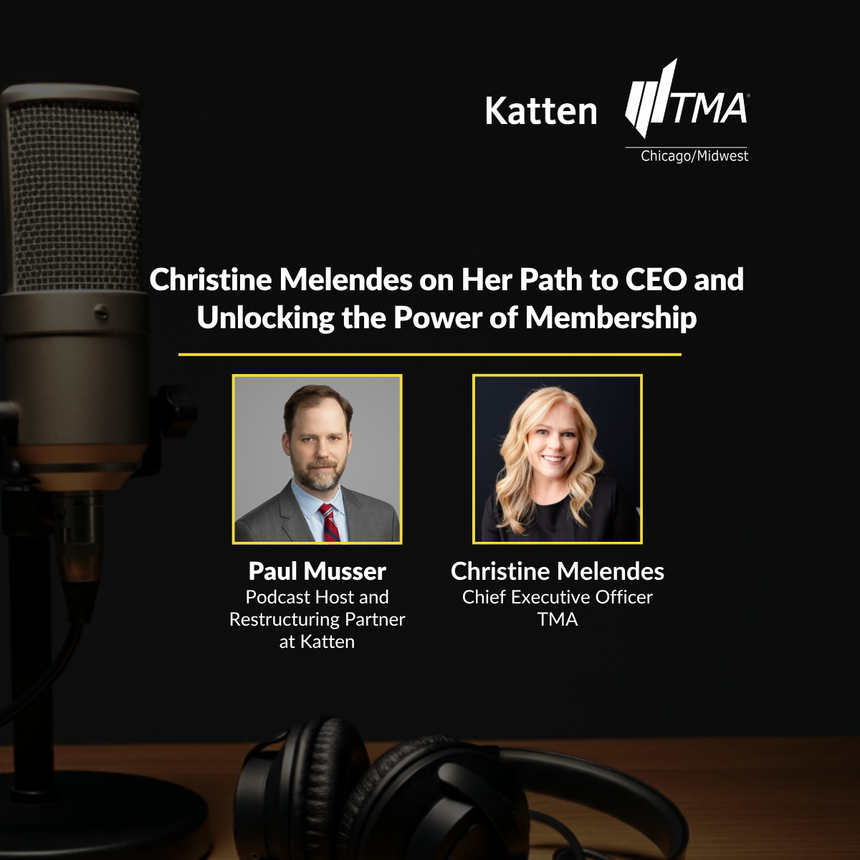
In the latest episode of the Turnaround Management Association’s (TMA) Chicago/Midwest Podcast, Katten Restructuring Partner and host Paul Musser sits down with TMA Chief Executive Officer (CEO) Christine Melendes to discuss her career path, early priorities in the CEO role and her vision for the organization’s future. Christine shares how her diverse background in association management, operations and business development prepared her for leadership at TMA and delves into why she was drawn to the organization’s members and mission. Their discussion also explores the value of chapter involvement, the power of TMA’s global network and how professionals can get the most out of conference attendance and volunteer opportunities.
Paul Musser (00:11): In this episode of the official podcast of the Turnaround Management Association’s (TMA) Chicago/Midwest chapter, we have with us Christine Melendes. Christine is the Chief Executive Officer (CEO) of the Turnaround Management Association. She started in this role in March of this year. Christine brings more than 20 years of leadership experience in association management. She previously served in senior roles with organizations such as the Association for Corporate Growth (ACG), where she built strategic partnerships and drove member engagement. Her experience also includes growing membership programs, managing operations and leading innovation across complex global networks. Welcome to the podcast, Christine. Thanks so much for joining me today.
Christine Melendes (00:53): Thanks, Paul. It’s great to be here.
Paul (00:55): We’re excited to have you. I wanted to talk first with you about your path to becoming CEO of TMA. Can you describe your journey in association management that led you to this point?
Christine (01:07): I love this question because it gives me an opportunity to talk about the breadth of the industries I’ve worked in. While I’ve focused a lot on operations and building associations, I’ve done that across a variety of industries. I love that connection to the work that TMA members do, which spans many different industries and companies. I’ve worked in the food service industry, hospitality, equipment manufacturing and even automotive aftermarket parts, and everything in between. I’ve had a long and lovely career. I spent a good amount of time working in financial services, private equity and investment banking, and the opportunity to work with TMA is icing on the cake of a career that I’ve enjoyed. All of that experience has involved building membership, structuring how organizations handle sponsorship, engaging people in networking events and working across the gamut of marketing, advertising and sales. Coming here and looking at this operationally is a thrill.
Paul (02:20): It’s a wonderful and diverse background to bring into an industry that celebrates and requires us to be agnostic about the industry while developing expertise across a variety of fields. You touched on this a little bit, but why TMA? What is it about the organization and its mission that attracted you to this opportunity at this time?
Christine (02:45): I had such a great career with ACG, which I consider a cousin organization to TMA to a certain degree. Having spent a little over 12 years with ACG, I first and foremost loved the professional persona and demographics of its members, and I saw a lot of that within TMA. These are people who are hard-driving and focused on results — things that I feel I’m particularly good at. Coming into an organization that is thriving and finding success by doing some of the very same things I’ve done in my career was exciting to me.
Paul (03:27): I definitely agree about ACG, too. I feel we’re all part of the same continuum, the circle of life. We’re cousins in terms of the types of deals we handle, just at different points in the financial life cycle.
Christine (03:43): Everybody hopes their business will be successful, but when it isn’t and there are bumps in the road or the business is headed toward a cliff, knowing that an organization like TMA has professionals with the capacity, skills, knowledge and experience to come in and right that ship is an amazing connection.
Paul (04:07): Absolutely. We’re recording this podcast for the Chicago/Midwest TMA chapter. You have a strong connection to this area and the city. Can you tell our listeners a little about your Chicago roots and ties to this area?
Christine (04:20): I wasn’t born here in Chicago, but I moved here a long time ago — almost 30 years now — and have lived most of that time in the city, in areas such as the South Loop and Southport. I recently moved out to Wilmette because my son started his senior year at Loyola Academy. Getting closer to school was important because he’s a hockey player and everything was on the North Shore, so it made a lot of sense for us to move. I’ve been enjoying suburban life for the last few years and helping usher him into his next phase of life. I’ve done some fun things in the city. I don’t talk about this a ton, but I went through the Second City training program, which is something you could do only in Chicago. It was a long time ago, before I had my son, and it was like going to kindergarten every Saturday. That was fun. Being on the main stage where John Belushi, Tina Fey and Amy Poehler performed was a dream come true. It was so fun.
Paul (05:24): It’s fun performing in that way and being in front of a crowd. Before I was a lawyer, I was actually a musician, so I understand having a prior career or interest, especially in the entertainment industry.
Christine (05:39): Yes, it satisfies something and pulls the thread of creativity in a new and unique way.
Paul (05:44): I also think that, when it comes to turnaround and restructuring, that creative outlook can be important. We’re dealing with problems that are usually unique each time, and there isn’t a playbook for many of them. Having an open mind and being creative throughout the process is a real benefit.
Christine (06:05): To stay on that topic for a second longer, I think one of the best gifts I was given mid-career was the ability to listen and receive feedback from a scene partner or, in business, harsh feedback or criticism. I learned that there are no “yes, buts”; there is only “yes, and.” So, this is what’s happening, and here’s what we’re going to do about it. That helped ease the anxiety of going on stage and performing, because I never knew what I was going to get. It’s the same thing you face in business daily: what are you walking into today, especially in a restructuring where emotions are high, and stress levels are astronomical? I feel that was a valuable training ground, and it probably contributed to the career successes I’ve had.
Paul (07:05): That’s wonderful. As we noted, you started your position as CEO in March of this year. What have the first few months been like, and what priorities have you set early in the job?
Christine (07:18): This is a fun question because, building on our last conversation, every day has been different. It’s been a wonderful opportunity to hear from so many people. I’ve been trying to do a lot of listening, and I’m embarking on the next step in that process. These first six months have been great. First, I’m trying to make us more operationally sound by assessing systems; the unsexy work that happens behind the scenes, but is critical in a member organization. Everything has to work together, and everyone has to grow in the same direction. Making those quick assessments and getting things aligned has been a major part of the role.
On top of that, I’ve been listening by joining committee calls, engaging with chapters and regional events, and hearing from constituents. I recently launched a quick Formstack survey. One question asked, “If you were CEO for the day, what would you do?” I’ve been enjoying the responses because they’re aligned with what we’re planning and how that work will be shaped in the next phase. Listening, shoring up operations and recognizing that nothing was completely broken, but there was enough to examine and ask, “How can we do this better?” have been the focus.
Paul (08:42): That completely makes sense. Based on those conversations and your initial experience, what is your longer-term vision for TMA over the next few years?
Christine (08:55): One priority is the next phase of this strategic assessment, which is creating the framework for what’s next for TMA. It’s not a retrospective; it’s not going back and asking TMA members how their membership has gone. It’s asking, “Where is this industry going? How does TMA need to be ready to support you for what’s next, and what is that next thing?” That strategic assessment launched this week with our executive board. I sent out a link to a more extensive survey exploring topics and areas of thought around where we should be going. How are people thinking about artificial intelligence (AI)? How are people preparing for what’s next economically? I want to hear from members — not just committee members or highly engaged people within the organization, but the full membership, nonmembers, customers, clients and whoever else we want to hear from — about how we create what’s next for TMA.
I can’t tell you exactly what’s next for TMA right now, but we are actively engaged in finding out where people think we need to be. Then we want to meet them there with the tools they need to be ready and successful, and to sustain their profession. Looking back at the associations I’ve worked for in different industries, every industry, from hospitality and food service to financial services, has been greatly affected by external forces over the last 25 years, and each has had to pivot and make changes. The associations that serve those organizations need to change as well. This is not something new; we’ve been through many cycles before, and now it’s our turn to figure out what’s next. I’m calling it TMA 2030: not the next 10 years, but the next three. How much will change, and how do we get ready for it?
Paul (10:53): Absolutely. What I hear most often about change is a focus on technological change as the main driver or concern. Some people are concerned about it, while others view it as an opportunity, and much of that discussion focuses on artificial intelligence and what it will do to our industry and the professions within it. Have you had discussions with people about those concepts as part of where TMA is going and what it will address?
Christine (11:27): We definitely have. Two volunteers, Ken Yager and Ed Schaffer, are leading an initiative to offer five to six webinars or courses on AI, creating a baseline offering around what’s happening in this area. Those are launching throughout the fall and at the Annual Meeting at the end of October in Houston. I think that’s our first step. It’s about understanding what we know now and getting the information out; there’s a game plan for that. Those two are doing amazing work, and I’m grateful they had that foresight. We’re ready to share interesting information, so watch for it.
The next question is what will build from there. Is there a possibility of a new certification or certificate program? Is a deeper dive needed? Does something else need to change so we’re ready for it? If we had a crystal ball, we probably wouldn’t be here, but things are going to change tomorrow. How will we be ready? I’m excited about the work they’re doing.
Paul (12:34): We’ve talked about this already as part of our conversation, but why should restructuring professionals who aren’t members consider joining TMA?
Christine (12:45): It’s a great question. As we’re looking to the TMA of the future, TMA is the place to find the experts who will help those businesses. I believe that if you’re in this industry and doing this work but aren’t a TMA member, you’re not as qualified as a person who is, because a TMA member has 9,000 professionals behind them and a wealth of education at their disposal. They also have the wherewithal and intuition to know that being part of something bigger makes everyone bigger. Success breeds success. Building this next version of TMA is the stake in the ground: TMA is the place to find restructuring professionals. You want to go to them because they’ve taken an active interest in making this the place where things get better, collaboration happens and best practices are shared. That’s the winning proposition for becoming a TMA member. If you’re not here, you’re not taking your role as seriously as someone who is a member, and I think that’s an important distinction.
Paul (14:06): What I like most about TMA is the diversity of the professionals who are part of it. It isn’t focused on one profession. I’m an attorney, but when I go to a TMA event, I’m surrounded by financial advisors, investment bankers and lenders, and people working on those deals. When we’re working something out or restructuring, it takes a village. Being in front of all those people lets them know I’m available if they need me. Just as importantly, when I have a deal and need someone I’ve met, talked to or worked with at TMA, having a variety of qualified people to draw on makes sourcing deals much better and easier. That’s the special sauce of TMA and why I participate as much as I do.
Christine (15:05): It’s that signal, that one green flag that says, “This person is like me and can help me.” I think that if you’re just talking to the same people, you’re in a vacuum. You’re having a one-way conversation. But getting a referral from an insurance professional you met, a lender you know or another attorney is priceless. You can say that a networking event didn’t help your business, but I don’t think that’s quantifiable. You’ve probably gotten a lot of business from being engaged, from someone seeing you on a panel or from someone thinking, “That’s somebody I should call.” It’s important to recognize that. You can hustle on your own to a certain degree to get where you want to go, or you can be part of TMA, and maybe the road is a little smoother.
Paul (15:59): Absolutely. Much of our audience consists of restructuring professionals who interact with TMA mostly at the chapter level, especially here in Chicago, where we have a large and vibrant chapter. Can you tell them about the distinction between the local chapter and the larger TMA organization, and the different opportunities that may exist?
Christine (16:23): You have a great community here in Chicago, and I’ve attended a number of events. I was at the Large Cap event a few weeks ago, which was amazing — David, shout-out to you. The chapter is your heart, the pulse of what’s happening in your local community. If you’re doing deals in this area, this is where you should be and where you should be networking. Then you can step out and look at regional opportunities to meet people from Indiana, Wisconsin, Michigan, and however far you want to go within your regional definition.
Paul (16:59): Here, it would be through MARC (MidAmerica Regional Conference), the event we hold each year. Last year’s event was in Detroit, and I think next year’s will be in Minneapolis. It is a great event.
Christine (17:06): Then you get the opportunity to meet professionals who’ve been doing much of the same work — breakfast meetings, happy hours, networking, and educational sessions — but in their local communities. You can ask what’s going on there, what the business environment is like and whether you can make referrals. Then you reach the global level, where we have many events. There is the Annual Meeting in October in Houston and the Distressed Investing Conference in early February in Las Vegas. Those events let you see the broader domestic deal community. It’s a great opportunity to take the blinders off and open your aperture to ask what’s happening across the country, where we’re seeing deals and what is happening in different areas. Sometimes things pick up speed from east to west or west to east — if something starts in California, we see it in Chicago and then New York, or vice versa.
We also bring in an international crowd. TMA Europe holds several annual events, and there is a large international chapter network. The misperception is that there is one international group and that’s the end of the story, but there are 4,500 additional members internationally beyond those in the United States and Canada. If there’s a deal, business, or manufacturing plant in India, you can go to TMA and find Indian connections to help make it happen. You can reach Australia, Singapore, Romania, London, France, Norway and Switzerland. If your work takes you to those areas, you can find local experts through your TMA network. The global organization wraps everything together in a pretty bow, but each member decides how to engage. There is a path to leadership at the chapter level and at the global level, along with learning and exposure that come with those opportunities. My advice is: if you’re new to TMA, get involved early, often and for as long as you can, because that’s where the real magic happens for your association membership.
Paul (19:38): You mentioned a number of these conferences, and as part of your position, I know you attend many of them. Conferences can be intimidating, and people may be trying to figure out how to get the biggest bang for their buck. What is your advice for getting the most out of these events and navigating them?
Christine (20:00): My first piece of advice is to register. Get there. It can be hard to make the time, but it is worth it. Once you get there, you’ll be happy you did. My second piece of advice is to do your homework before getting on an airplane. Find out who’s going to be there, post on social media and reach out to plan dinners, breakfasts, lunches or meetings. Don’t wait until you’re there, because most people are already booked and plans have been made.
Three to four weeks out, think about how to get the most out of the event. This year at the Annual Meeting, we’re doing a first-timer orientation. If you haven’t attended one of our Annual Meetings before, which I haven’t, since I’m new in my role, it’s a great opportunity. I’m excited about it. You’ll meet other first-timers and can create your own little group, giving you people to check in with. I like the spoke-and-center metaphor: you have a group, go meet people and then return to your safety net. There’s nothing wrong with that, especially if you’re introverted or uncomfortable in a large crowd. Find people with similar interests and move from there. Follow up when you’re back. Send a note to the person who invited you to dinner or someone you met in a random hallway conversation. That’s where a lot of great things happen, through hallway conversations or bumping into someone you haven’t seen in 10 years and rekindling the relationship.
Paul (21:36): I think the follow-up is important. It’s one thing to attend these events and meet people, but if you don’t continue to water the seed you’ve planted, the plant won’t grow. You have to foster and continue developing those connections after the events if you want them to become fruitful. It’s not as if you show up to a conference and a deal falls out of the sky the next week. It takes time, and you have to be mindful of and deal with that lag in between.
Christine (22:09): One other important part of your boots-on-the-ground strategy is figuring out which educational sessions to attend. What will give you a leg up in a conversation you have planned for tomorrow or a couple of weeks from now? Sitting in a boot camp or one of our educational sessions is an opportunity to meet people in a safe setting while also gaining a new skill that you can take back and implement in your position. That’s valuable: you invest in yourself, attend the event and an educational session, get something out of it, implement it and meet two people. All of a sudden, the value of your membership, dollar for dollar, is greater, more impactful and personally rewarding.
Paul (22:58): I’ll give a shout-out here. For the TMA Annual Meeting, I’m participating in the subcommittee putting together a private credit panel. For anyone in that field, it would be valuable to attend. We’ll discuss distressed situations and private credit, trends we’re seeing in workouts and related issues. Just being in that room will put you shoulder to shoulder with other people in the industry, so you’ll get the benefit of the content as well as the opportunity to meet people in that particular sandbox. Being mindful of the events you plan to attend and socializing with the people who are there both have real value.
Christine (23:47): I love this private-credit segue, Paul. If we can go off on a tangent for a second, I think bringing private credit more thoughtfully into the fold is a growth opportunity for TMA. We can make TMA a resource for those professionals and coordinate efforts to bring them in, giving our members the opportunity to meet everyone and grow from the ground up. Some additional bench strength is always valuable.
Paul (24:21): I’ll make a second pitch. On September 17, the chapter is holding its annual workout lender panel, which I’ll moderate. We currently have four lenders, two of whom are private credit lenders. We’ll discuss issues they’re seeing across a variety of industries and loan types. The great thing about this event is that it’s being held alongside the Capital Marketplace event, so I think we’ll have close to, if not more than, 200 people in the room. I recommend it to anyone listening, and this should come out in advance of the event. If you’re interested in learning more about private credit and what’s happening generally with distressed loans, it’s a great opportunity.
Christine (25:08): If someone is listening from outside Chicago but is active in their chapter and wants a session of that kind at the chapter level, they should raise it with chapter leadership: “Chicago is doing this. You can reach out to them to learn what they did, and we can bring it to our region.” That’s another effective way to connect and keep everyone moving.
Paul (25:32): You mentioned the path to leadership in TMA. Do you have tips for people looking to expand their roles within the organization? How can they develop or move into those positions?
Christine (25:46): You have so many good questions, Paul. I think one of the first things to do is get involved. I know Chicago has a large and effective governing board, and there are many board opportunities. Each board role has committees that support it. If you’re interested in Next Gen or another area and want to meet the relevant board leader, reach out. The leaders are on the website, and the information is available. Raise your hand and ask for an opportunity to meet someone. I met a woman named Cynthia, who is just beginning her TMA membership, and she has been raising her hand and working on Next Gen women’s initiatives in Chicago. It takes one decision to raise your hand, say you want to do something and find an advocate to help you through the process. That could be your chapter president or someone you know on the board.
There are many opportunities to get engaged, and the same is true globally. If you want to get involved, answer the call for volunteers, put your name on the list and see what happens. Figure out where your skill set can be used and volunteer to help. A lot happens through board work, and the growth and other initiatives at TMA will come through volunteer leadership. The people who will make the magic happen are the volunteer leaders. We have great volunteer leadership, with Brian, Rachel and Frank coming on board, along with all the committee vice presidents. Everything is done at that level. If you want to get involved, raise your hand, take that step and have some fun doing it. It’s also a great way to meet others in the industry. Getting involved serves multiple functions. The path is either chapter or global; decide which you want and test the waters.
Paul (27:55): Absolutely. I previously served as vice president of education, and I’m currently on the chapter’s communications committee. We’re always looking for people to join committees, and we’re happy to add more people. We appreciate the time and effort they contribute. It’s a great way to work with people before you officially work with them on a paid matter. You can show everyone what you can do and that you’re reliable, so when actual work comes later, they’ll think of you because you’ve been visible and done good work. It’s a good test environment to help develop your book of business.
Christine (28:35): You can also expand your skill set. If you have a narrowly defined role earlier in your career and want broader management experience, committee and volunteer work are excellent opportunities to hone those skills and make yourself more marketable for everything that follows.
Paul (28:59): Do you have any broader business development tips or advice for our audience, particularly professionals looking to grow their restructuring practices, or those closer to starting in the industry?
Christine (29:12): My advice may be getting old, but it’s to get involved and not be afraid to attend an event. We had our Global Next Gen event in Atlanta a couple of weeks ago, and it was sold out. The Next Gen professionals were an impressive group. The chairs, Kate and Reggie, did a great job and engaged people. Don’t be afraid to have a conversation with a stranger. My biggest business development advice is to say hello to everyone. You can’t do business with someone you don’t like, so work on how you come across and learn how to network.
If you need help networking, many people will help you. Developing rich relationships within your TMA network may yield 50 percent or more of the business referrals you receive from people you’ve met through TMA. That’s a huge piece. There is an opportunity to sell and an opportunity to listen, and TMA gives you space for both.
Paul (30:22): I completely agree. Two of the largest deals I had last year came from contacts I made through TMA or from people who served as panelists at an event I moderated. I got to know them through that process. I think that is invaluable. As a moderator, it’s a great excuse to meet your panelists, reach out to new people you don’t know and work with them, and reconnect with people you do know. You also get to be on stage in front of a large audience of professionals. You can frame the discussion around smart people and draft off of them for that audience. In all those ways, it has been invaluable as I continue to grow my practice and business.
Christine (31:12): I’m going to steal that for a testimonial, Paul.
Paul (31:16): Please go ahead, I would appreciate it. That would be great. Well, thanks so much for joining me today on the podcast, Christine.
Christine (31:24): Thanks, Paul. I’ve appreciated talking to you. Talk soon.
Paul (31:27): Absolutely. Our guest for today was Christine Melendes, the CEO of TMA. I’m Paul Musser. Thank you, listeners, for tuning in. This has been an episode of the TMA Chicago/Midwest Podcast. Please rate, review and subscribe wherever you get your podcasts.
/Passle/5fb3c068e5416a1144288bf8/SearchServiceImages/2026-10-12-21-33-47-025-6acd523bc73178b1cd9448b4.jpg)
/Passle/5fb3c068e5416a1144288bf8/SearchServiceImages/2026-10-12-16-37-45-898-6acd0cd93a2af61876051cca.jpg)
/Passle/5fb3c068e5416a1144288bf8/MediaLibrary/Images/2026-10-06-20-06-22-572-6ac554be4e3377a132b4bb3f.png)
/Passle/5fb3c068e5416a1144288bf8/SearchServiceImages/2026-10-01-11-31-16-673-6abe4484864f593e513405f6.jpg)