



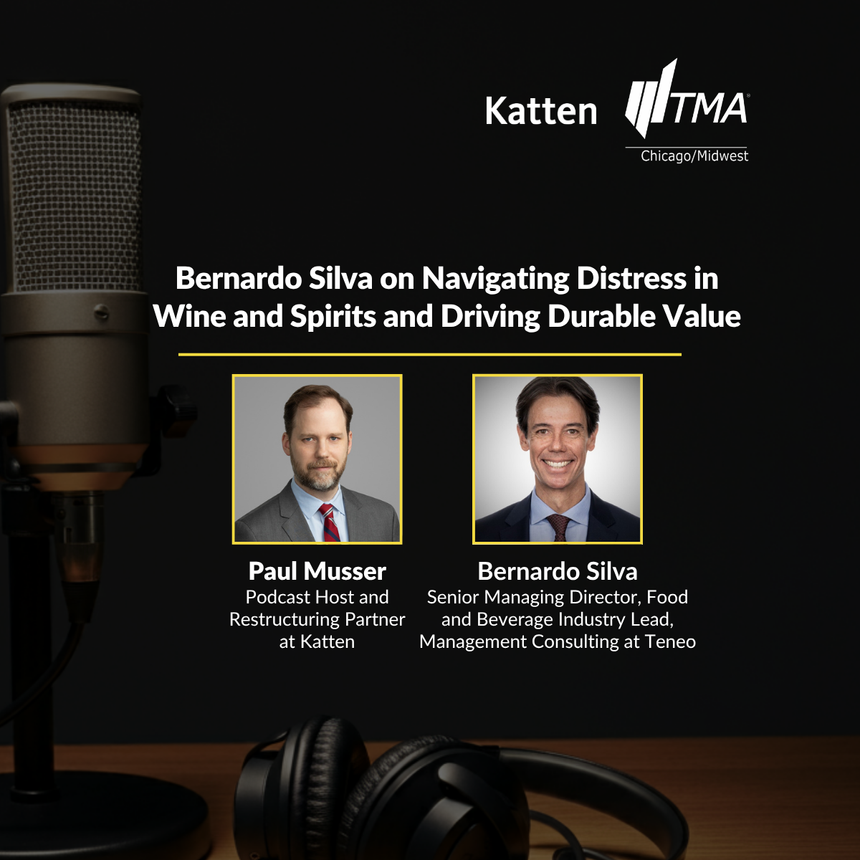
In the latest episode of the TMA Chicago/Midwest Podcast, I sat down with Teneo Senior Managing Director Bernardo Silva, food and beverage industry lead within the company’s Management Consulting team, for a candid look at the distress reshaping today’s wine and spirits industry. From a non-traditional restructuring professional’s perspective, Bernardo discusses the sector's path from a pandemic-fueled boom to consumption that has continued to fall since 2023, leaving weak balance sheets, inventory gluts and a wave of bankruptcies and restructurings in its wake. He and I also unpack the structural consumer shifts, from the "sober-curious" generation to alternatives such as cannabis and GLP-1s, that are also driving the sector’s downturn. Finally, Bernardo shares his insights on business development, highlighting proactive networking and early intervention as a restructuring professional's greatest assets.
Paul Musser (00:11): In this episode of the official podcast of the Turnaround Management Association's (TMA) Chicago/Midwest chapter, we have with us Bernardo Silva. Bernardo is a senior managing director at Teneo's Management Consulting business based in Chicago, with over 25 years of experience as a senior advisor and operating executive.
Bernardo works closely with management teams, boards of directors and private equity investors to unlock transformative growth and accelerate value creation. He also serves as the food and beverage industry lead within Teneo's management consulting team. Welcome to the podcast, Bernardo. Thanks for joining me today.
Bernardo Silva (00:49): Happy to be here, Paul.
Paul (00:51): So, the question that I always start off with – why restructuring? What led you to a practice that involves restructuring?
Bernardo (00:59): It's an excellent first question, because I'm not a restructuring professional, but I work very closely with my restructuring peers. Most of my career, Paul, I've spent time on the revenue line of the P&L (profit and loss statement). I have grown up in sales and marketing. I was early in my consulting career, a strategy consultant, so I've always helped clients unlock growth … in a sustainable, profitable way, of course.
In that journey, I've always worked with clients with performance issues, clients who were underperforming. But it was not until several years ago, when I joined my former firm AlixPartners, that I encountered situations where clients were facing financial distress. They could be facing really serious financial issues, liquidity, insolvency … and that's when I started to work more closely with restructuring professionals.
Paul (01:54): For those of our listeners that aren't familiar with Teneo, can you give them some background on the firm, what it does and the market that it covers?
Bernardo (02:03): Yes, of course. Teneo is a global CEO advisory firm. It's not that we only serve CEOs, but we tend to work on issues that are in the CEO agenda. And because those issues tend to be very complex, they require multidisciplinary competencies. We have created a really diversified set of services that are organized along five lines of business. So let me just give the highlights of each.
Of course, financial advisory: that's where we have our turnaround and restructuring team. That team is 700 consultants strong with capabilities all over the world. And that team was built mostly through acquisitions. We acquired restructuring business from Deloitte, from PwC, all over the world. The business where I sit – that's the second business, management consulting – very traditional management consulting practice, as you would find in firms like McKinsey, BCG, LEK or Kearney. You know, it's that type of pedigree that we have in our practice. The third business, which is actually our largest business and how the firm was founded, is what we call strategy and communications. That's corporate communications, including investor relations. We are the advisors on the investor relations side to multiple FTSE 100 and Fortune 100 companies, and we also have in that business our government affairs, which deals with policy advocacy, economic impact analysis, regulatory affairs and so on and so forth.
And finally, two smaller businesses we have: a people advisory business that does largely executive searches for C-suite and board roles. And we have a risk advisory business that is deep into physical and cybersecurity. So that's the makeup of the firm. The beautiful thing about Teneo that a lot of people get surprised about is the depth of capabilities in each one of those individual areas, but they all come together in an integrated way to tackle our clients' most difficult problems.
Paul (04:13): And just from listening to the breadth of what you cover, I mean, obviously being able to handle all those different services is very valuable when it comes to any type of restructuring if you find yourself in one. So, going back to you … when you're involved and when you've been dragged into the dark arts of restructuring, what roles do you typically play? What types of deals do you most often find yourself involved in?
Bernardo (04:38): You know, that's an excellent question, because as a non-traditional advisor working restructuring situations, my role typically is a little bit different, right? You will have the people who live and breathe this environment, going deep into the nuts and bolts of turnaround and restructuring or a bankruptcy situation. My role is typically in two areas: number one, as part of the performance improvement plan, making sure that we have other levers that we can pull to improve margin profitability and generate revenue that are not just technical cost cutting.
And there are a number of those levers that sit in my side of the equation; for example, how to deploy pricing in a smart, near-term way, and how to avoid costs that are avoidable. For example, late delivery fees, if you're delivering product to a retailer, or detention and demurrage charges if you're shipping products across the ocean. Also, cost recovery … that's usually a forgotten lever. Costs that you incur that your customers may acquire, that you may be able to upcharge for, and hence create additional revenue in the near term. So, I usually play a role in that aspect. I like to call it margin expansion, as opposed to cost reduction. And the second role, Paul, is making sure that there's a sustainable growth plan for the recovery to be durable. And it's hard enough to get out of a near-term pinch, but it's equally hard to create something that is durable for the surviving entity.
Paul (06:15): I think that operational part is very important. I think a lot of times, restructuring professionals tend to get focused a little bit too much on fixing the immediate finances or, you know, the financial vehicles that are in place. And I think, a little bit less so, of trying to fix the long-term operational issues so that even when you've fixed the books and fixed the capital structure, there's something good in place with a powerful plan to be able to take the company to the next step and make sure that it doesn't end up right back in the same place in a few years’ time.
Bernardo (06:50): Absolutely, absolutely. But, unfortunately, there's no long-term without fixing the short-term. So, it's a really neat balance because again, of course, coming from where I come from, usually there's a little bit more runway, there's a little bit more patience to get to a value-creation solution for the types of clients that I normally serve. But in that type of environment – this is something that I actually learned a lot with restructuring professionals: work at pace with a sense of urgency, be practical, focus on the things that matter 80/20, and move with confidence, because there's no time for second-guessing decisions. But those are all new things that even, having been a consultant for a quarter century, I have learned with your peers in in this industry.
Paul (07:44): Yeah, to me, it's that liquidity runway that really drives the need for speed and efficiency. And I like the fact that you added confidence there too, which is, you know, you need to have people that are willing to make decisions and take steps to move the ball forward. There isn't the time to hem and haw and second-guess. I mean, you need powerful leaders that are willing to take steps forward and grab the proverbial bull by the horns to get the company to the next level.
So, what are the steps to further the ends that we just talked about, that you oftentimes take at the outset of an engagement? When you first parachute in and you're brought into a restructuring situation, what are those initial steps and measures that you find yourself doing?
Bernardo (08:30): Yeah, so the focus on value … that's first and foremost. And value comes in many different ways, right? And in any restructuring situation that I've been part of, that may be liquidity, so the focus immediately shifts to receivables, payables and working capital. How can we actually sell the things that we have in the back of the house as quickly as we can without creating long-term implications? Sometimes, it's really a profitability issue, and the company is in the red, bleeding day in and day out. So again, on my earlier point about being practical and looking for solutions that can deliver near-term impact without creating problems down the road, that's usually the first thing to do.
Sometimes, that needs to be done in a matter of a week or two. Sometimes, we have a little bit more time to be thoughtful, but it's really creating that portfolio of interventions, so those quick interventions, done in a very thoughtful way with a sense of value creation, in a practical manner, that's usually where the conversation begins.
Paul (09:42): So, one distressed area that we did talk about before recording the podcast was wine and spirits. Let's pivot toward that as our main topic for the day. There have been several stories this year about severe distress facing that industry. What are you seeing in the wine and spirits place just generally?
Bernardo (10:06): Yeah, I know it's a fascinating time and not a very easy time for distilleries and wineries in the US. As you mentioned, I cover food and beverage for Teneo. I've been in that space for a long time. The way I would summarize it is to say: there was a pandemic induced boom. We were locked in our houses, and consumption of alcohol increased significantly, despite the fact that none of us could go to bars and restaurants. That drove very meaningful capital investment. You know, people in the industry really believed that it was a sustainable shift, so a lot of capital deployed in equipment purchases, facility improvement.
What happened, and this was really, you know, shortly after the pandemic – 2023 – we started to see signs of what became known in the industry as normalization. So, consumption started to go back to pre-pandemic norms, and we are now below pre-pandemic norms. Consumers have changed in significant ways, which we can explore further. But the reality is, this is an industry that has a ton of fixed capital, a ton of capital tied in inventory, and consumption hasn't really matched their expectations. So, as you can imagine, there are a lot of very weak balance sheets out there. And unfortunately, I think that what we have seen in terms of bankruptcies and flash sales in the space, this is not going to end anytime soon.
Paul (11:38): So, we talked about some of the headwinds: there being falling demand, oversupply, maybe a shift in consumer habits. Are there other headwinds that you're seeing facing this industry? Any effect from things like tariffs or anything else that you're seeing out there right now?
Bernardo (11:56): Yeah, let me maybe start with a double-click on the consumer dynamics that I was talking about, because it bears the question: how much of what we're seeing is structural, and how much of what we're seeing is cyclical? Tariffs are a cyclical component, but I think the fundamental issue is how the consumer has changed. Number one, health and wellness has been a topic across many food and beverage categories. It's no different for alcohol. You know, we have a generation that is sober curious, and that is a lot more focused on health and wellness, who think about drinking better, not more. That is an overarching generational trend that I think is here to stay.
At the same time, you started to see different options that consumers could seek for their beverage occasions, including fermented malt beverages or FMBs (hard seltzers being the prime example of ready-to-drink alcoholic beverage), your spiked tea, your High Noons, your pre-mixed cocktails. And all of those have created options. So, consumers have moved away a little bit from straight alcohol, wine, or other forms of spirits, even beer, because options have fragmented. And on top of that, you have two other things that sometimes people forget. Number one: cannabis. With the legalization of cannabis in multiple states, it created a competing option in some of the alcohol occasions. And the impact of GLP-1 adoption, which reduces cravings, and there's some evidence that it also reduces alcohol consumption. So that is just to say, that not only is there an indication that there is less consumption on a per capita basis, but the situations where there's consumption have become more fragmented.
Paul (13:53): You had mentioned the issue of oversupply before. In some ways, there is a unique component when we talk about especially spirits, or certain types of spirits. Could you delve into that a little bit, given the fact that some of these spirits take multiple years to basically come to market? How has that been manifesting itself in the distress that you're seeing right now?
Bernardo (14:15): Excellent question. Most of the producers, be it distilleries or wineries, realize the fact that there's a lot more supply out there. So, there's an inventory glut in the system that hasn't worked its way through yet. They have been taking capacity out year after year, but that supply continues to exceed demand. So, unless the demand comes back, that glut will continue. Now, you touched on something that is a little bit unique, particularly for high-end spirits. Your whiskey ages for 10+ years, right? So, there's a lot of stock that is in barrels. That doesn't depreciate. I think that's the good news. And actually, that inventory becomes more valuable as time goes by. The problem, however, is how long can you sustain that? So for distilleries that don't have the capital, who have weak balance sheets, working through those long multiyear cycles, it will be difficult.
Paul (15:04): Sure. Yeah, it's tough to blow out that inventory. It's not just as easy as trying to put it out to the market. I guess I wonder, you know, does that mean that we're just all gonna have much better spirits aged an extra five years, whether people like it or not?
Bernardo (15:35): There's a a lot of people in the industry who believe that that's going to be the case. So, if we live long enough, we're gonna be able to taste exceptional product.
Paul (15:39): We'll just have to all be patient.
I'd also read ahead of this, just about the effect, in particular, on California wineries, that there's been more distress, layoffs and the shutting down of different sites. Have you seen that out there in that particular segment of the industry?
Bernardo (16:02): Yes. As I said, it's not a pretty picture. And it's not just in California; Oregon, Washington state, upstate New York, Texas (actually a big producer). California, of course, is, if I get my stats right, something close to 80 percent of the domestic production, so all eyes are on California. There are a lot of challenges related to what we were talking about, to demand, but there are also challenges related to labor. We sometimes forget that there are other parts of the economic picture that impact wineries. Climate change, that's also a consideration, but as I said, it's not a pretty picture.
And when you look across beer, wine and spirits, wine has been the one most affected by the change in dynamics in consumption. I think some of the latest numbers from Circana and Nielsen point to something like, you know, 6 to 8 percent decline in volumes year after year. So, we're not talking about a small amount. in an industry that is significantly fragmented. There are around 11,000 wineries in the US. The top ten wineries, of course, represent the bulk of that. So that's just to say that there are thousands and thousands of wineries that produce very little, that don't have the strength of a balance sheet, and who don't have private money backing them. So, those are family operations that may be significantly challenged in the years ahead.
Paul (17:42): I wonder then also … I've seen a lot of distress in the agricultural space as well. I wonder if this will have a knockdown, sort of downstream distress with respect to growers of, let's say, grapes or what have you. It's like the beginning of dominoes, you know, one falls and then it sort of ends up knocking down a few more on the way. I don't know if you have any experience at all with growers or the agricultural side of the space, but it seems to me like it could be something that could also hurt those folks, too.
Bernardo (18:11): It’s all interconnected, Paul. It's all interconnected. Even the conflict in the Gulf, one of the consequences is the increase of fertilizer cost, so, you know, once it becomes time to fertilize the land, costs are going to increase. Costs of fuel have already increased. You need to haul grapes up and down California, and California's a big state. Sometimes we think about wineries as, you know, this vertically integrated thing, right? You have the vineyards and people go get the grapes, and they go crush the grapes and ferment them, etc. There's a lot of wineries who don't have their own vineyards. They may buy the grapes and crush them, and they may buy the juice, right? So, it's all interconnected, particularly in California.
Paul (19:00): So, what are the potential fixes then in this space when your team parachutes in and is working on these deals? What are some steps that people can take?
Bernardo (19:10): The very first thing that I like to do, which is actually not just specific to wine and spirits, is to have a really good grasp on product and customer profitability. You would be amazed how even very large companies don't really have a good grasp on where they're making money or where value is leaking. So, that's one of the first stops, and that can lead to a variety of things. You can rationalize part of your portfolio or discontinue distribution to some of your customers. It can lead to pricing action. It can illuminate areas where costs are out of control. So, that's one of the very first things that I like to do when we come into a performance improvement situation.
Paul (19:56): And then, are there unique challenges that practitioners should know about when working on a wine and spirits workout?
Bernardo (20:04): A number of them. One you touched on, which is kind of the low velocity of the inventory. Inventory moves in years, not days, as you would see in beer or RTDs, for example. Second one people forget is, that it is fundamentally an agricultural product for wine; specifically, it's a live liquid, so we are exposed to anything that happens on the agricultural side, as you mentioned. The third thing is in the US, we have what we call a three-tier system, which was put in place during the times of prohibition, which prevents producers from selling directly to retailers. So, there's a second tier, which is the distribution tier. And that is very important because that's what givesproducers access to markets. That's where producers can pull levers to accelerate sales. Those are all critical elements that, if you're going to be working in the industry, you need to be aware of.
Paul (21:00): That makes it sound much more difficult when you get in a workout situation. You don't have that convenient lever of “I'm going to look to my inventory and think that I can convert it as quickly as possible into cash.” So, I would imagine that if you step into a situation where liquidity is tight, there aren't a lot of great answers as far as creating immediate liquidity except for, if you had a sponsor to them and asking them to write a check, and/or going to the lender and having them double down. It sounds like a very tough space to be in once you get into a workout.
Bernardo (21:31): Yeah, the exception being, particularly for some of the higher-end wine resorts or the smaller states, they rely very heavily on their hospitality program, which includes wine clubs. And this is: you go visit a winery when you're on vacation in Napa, you taste their wine, and you pay for that. They're actually charging a lot more. Your average wine tasting in Napa will cost you $100 or more. And then you sign up for the wine club and then you get boxes of wine shipped to you depending on what state you live in. So, for some of those wineries, that can represent 40 to 50 percent of the revenue streams. So, there are ways, and I mentioned briefly now, the e-commerce, the out-of-state shipments, which is not a universal solution, but there are ways in which, you know, you can crank that revenue gear a little bit faster.
Paul (22:23): So then, if at the end of the day a business in this area is forced into some type of process, what processes are stakeholders often choosing or are lenders choosing for them to maximize value or recovery in these types of deals when they end up in a workout or restructuring or turnaround? What are you seeing in that regard?
Bernardo (22:45): I think there's a lot of things that are not visible because, particularly for wineries, unfortunately those wineries are too small to justify bringing in advisors. So, what I suspect, and I don't know that for a fact, is that a lot of those situations are going into liquidation.
Paul (22:53): Sure. And then I would think, even the ones where an advisor is being put into place, I'm sure that they are looking at the cost as part of the factor of if there's going to be a process, with the preference obviously being some type of out-of-court solution, if at all possible, to limit the spend on advisors. And then probably, if you are forced into a court, maybe we're talking about a receivership versus a bankruptcy, just given the fact that bankruptcies are so tremendously expensive and oftentimes are used more as a sales vehicle. I feel like now more than anything else, I would think there would be a preference towards out-of-court. And then, if you're in court, a cheaper option like a receivership to try to deal with those types of issues.
Bernardo (23:42): I think you're right, Paul. And one playing out very publicly is Uncle Nearest – not a pretty situation either, but during receivership, and that's the path that, you know, the lenders decided to take.
Paul (23:48): Let's pivot at the end of our conversation more toward a business discussion. I mentioned here that Teneo is a recent sponsor of the TMA Chicago/Midwest chapter. One of the things that I always like to talk with my guests about is their broader business development. Do you have any tips or advice that you can share with our audience while they pursue their connections and try to grow their book of business?
Bernardo (24:24): A couple of things that I would share, particularly in your environment: networking is absolutely critical with lenders, with law firms, with consulting advisors. You know, it's such a tight-knit community, and the community needs to be mobilized so quickly when a situation arises, that I think building your network, making sure that you have the right connectivity, that you're ahead of issues … we're just talking about wine and spirits. So, when anyone who has an interest in that, you know, go figure out who the players are in this industry.
But similar to that, or along those lines, one thing that is, again, as a non-traditional professional in this area, I've always felt that restructuring professionals tend to be a little bit more passive. It's waiting aggressively for the phone to ring. And I do believe that, of course, you cannot force a situation. However, you can try to get ahead of an issue, and you can try to mobilize it or mobilize resources to try to avoid a situation from getting worse, intervening quicker or earlier in the life cycle. So, I think the mix of networking and being proactive are things that can serve restructuring professionals really well because, and this is an outside analogy, otherwise, you are like a firefighter, right? You run toward trouble, and then when it's over, just wait for the next fire. I think there's more that can be done from a business development perspective.
Paul (25:55): I would agree completely on the time consideration, which is that time and money are such a valuable commodity when it comes to any type of workout or restructuring. So, the sooner that you can get involved, the better. And from a business development perspective, it's making people, I think, aware that those services are out there, so that when the time comes, they're not going to have to go through their Rolodex. You're just going to be top of mind, and they can reach out to you.
And it's also, I think, reaching out to people on a continual, consistent basis without, of course, being annoying, to just remind them that you're there. So, if it happens to have something where maybe it's not even in absolute distress right now – I have a lot of lender clients that talk about their shadowing deals – well, if you're letting them know that you're there and of your capabilities, and maybe your newfound wine and spirits experience, then they'll know that if they have one of those deals that they're shadowing, maybe to reach out to you a little bit quicker to give you a little bit more time to be able to be that professional who's able to work on it. So, I think the proactivity one is really important, from a personal, but then also from a process perspective, when you actually start doing the work too.
Bernardo (27:08):
Yeah, and to add more color … I tend to work a lot with the companies, even when they're not in a financial distress situation. The management team in those companies, they don't have the type of experience that restructuring professionals have, right? And they see raising their hands, if something doesn't look right or if they can anticipate that something will not be right, as an admission of failure. So, by the time lenders catch wind of something, it's probably already too late. So that's why I think, again, getting ahead of the issues, leveraging the network, being thoughtful, keeping an eye on companies … I can't count on even two hands how many companies I had conversations with, started to advise or tried to advise, and in one or two years’ time, they were hiring restructuring professionals. So, the earlier you can intervene, the better.
Paul (28:09): I completely agree. And I think it's particularly important, you're right, on the company side, to realize that a lot of times, this will be somebody's first go-round in a distress situation. It’s very different than when you have the lender hat on, and you're dealing with a special assets group who deals with it on a consistent basis. But to really have that in mind that you're going to need to walk these people through the process, and almost act a little bit helpful from a psychological perspective: like these are difficult times, but the sky's not falling. We can get our arms around this, but be clear-eyed about what the potential solutions are and the fact that if we act now, and we try to preserve time and money, that will be only a helpful thing going forward. So, I do think it's important to know the role and the clientele, and sort of where they're approaching it from the start of any engagement. That's very good advice that all restructuring professionals should keep in mind, especially with company-side work.
Well, thank you so much for joining me on the podcast today, Bernardo. Our guest for today was Bernardo Silva from Teneo. I'm Paul Musser. Thank you, listeners, for tuning in. This has been an episode of the TMA Chicago/Midwest Podcast. Please rate, review and subscribe wherever you get your podcasts.
/Passle/5fb3c068e5416a1144288bf8/SearchServiceImages/2026-10-19-17-03-32-820-6ad64d64203f8b556e180c14.jpg)
/Passle/5fb3c068e5416a1144288bf8/SearchServiceImages/2026-10-19-13-53-48-169-6ad620ec9559e780ab56b17e.jpg)
/Passle/5fb3c068e5416a1144288bf8/SearchServiceImages/2026-10-15-19-12-41-278-6ad125a90e7e30becd8e3a93.jpg)
/Passle/5fb3c068e5416a1144288bf8/SearchServiceImages/2026-10-15-21-36-52-140-6ad14774aa6596dee34af4a3.jpg)