



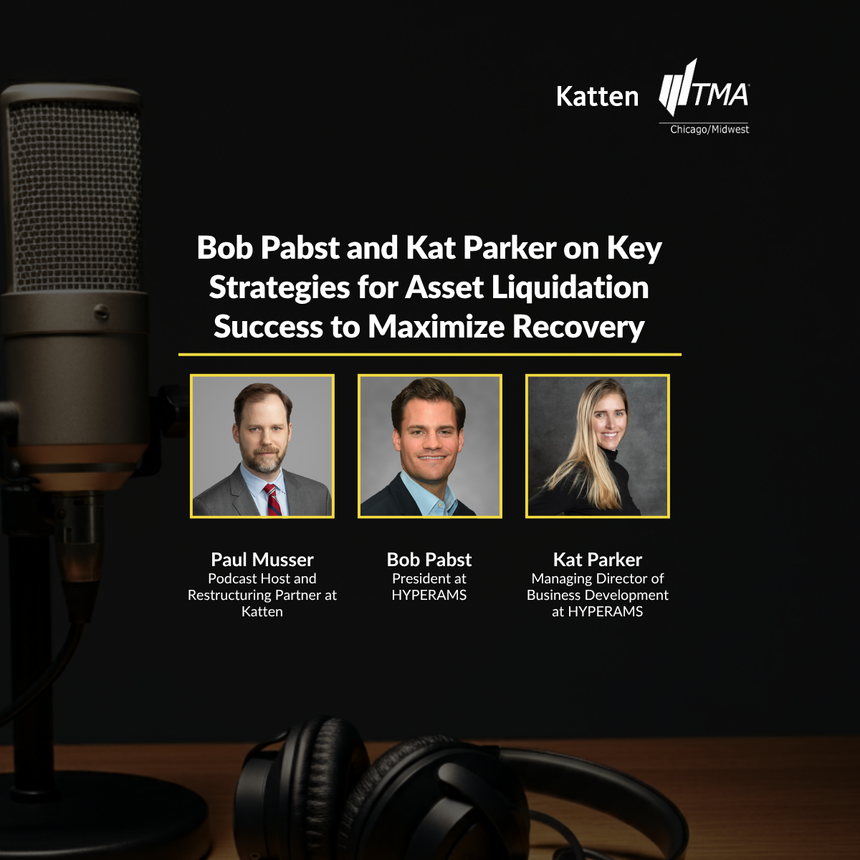
In the latest episode of the TMA Chicago/Midwest Podcast, I sat down with HYPERAMS President Bob Pabst and Managing Director of Business Development Kat Parker to explore the world of liquidations and wind-downs. Our conversation delves into each guest’s career paths in the restructuring field, how to create liquidations that maximize asset recovery, the importance of early lender or fiduciary outreach to integrate liquidators into the larger wind-down strategy, and current market trends impacting M&E values. Bob and Kat also share insights on the power of building relationships through professional organizations such as TMA, and why the restructuring industry remains uniquely relationship-driven.
Paul (00:11): In this episode of the official podcast of the Turnaround Management Association's (TMA) Chicago/Midwest Chapter, we are honored to have not one, but two guests, Bob Pabst and Kat Parker. Bob is the President of HYPERAMS. He joined the firm as Chief Financial Officer in 2018, before becoming Chief Operating Officer in 2021 and President in 2024.
Kat Parker is the Managing Director of Business Development of HYPERAMS. She joined the firm in 2012 and was responsible for the implementation of its auction operations and processes. Kat's current duties include establishing and maintaining relationships with machinery and equipment and inventory appraisal clients, as well as financial institutions. She is also an incredibly active member of several industry organizations, including TMA, where she is a past president of the Chicago Midwest Chapter. Welcome to the podcast, Bob and Kat. Thank you both so much for joining me today.
Bob (01:11): Hey Paul, thanks for having us.
Paul (01:14): The question that I always like to start with my guests is: why restructuring? What led you to a position that involves restructuring? Let's start with Kat first, and then we'll get Bob's take as well.
Kat (01:25): I don't think anyone ever plans to graduate college and go into restructuring. I was working for a startup company called DailyDAC at the time, and that was my introduction to the restructuring process. Through that, I met Tom, and I joined him at Hyper AMS over 14 years ago, which is kind of crazy. And I started doing marketing and general jobs with him. And I then started running our auction operations. I went to auction school and became a licensed auctioneer, and I still hold my license today. And as our company has grown and expanded my role, business development has really stayed in the auction side. But as we've grown the appraisal, and more recently, the field exam group, I focus a lot of my day-to-day on selling those services.
Paul (02:14): Wonderful. And how about you, Bob?
Bob (02:17): I was aware of the industry. As Kat mentioned, Tom Pabst, my father, started the firm about 16 years ago and had been in the liquidation and appraisal space prior to starting HYPERAMS. So, I was aware of the industry, and as he started growing the firm, we started a conversation about potentially working together. And after some time, I believed that the window for me to come on board and work with him and have an opportunity to take the company to the next phase — that window would close. And at some stage, he was going to look for a transition and a retirement option. So, things were, at least in my mind, winding down at the company I was at previously. And I decided it was time to join. That was, gosh, that was almost eight years ago. So, hard to believe time goes quickly. But yeah, that was my entry into the business.
Paul (03:27): Yeah, the theory or the theme here, I guess, is time flies when you're having fun, right? You know, eight years, twelve years, as long as you're having a good time. Next thing you know, wow, we're here. So, let's talk about HYPERAMS a little bit, Bob. For those of our listeners who aren't as familiar with the company, can you give them some background on the firm and what it does in the market that it covers?
Bob (03:31): That's right. Yeah, so we're a full-service asset valuation, monetization and advisory firm serving middle-market companies, generally in North America, although we have also done some work abroad. The valuation group, which Kat mentioned she works in on a daily basis, does appraisals for inventory and equipment, primarily for asset-based lending. We also do insurance appraisal and some other sorts of appraisal, but we really started in the ABL space.
As Kat mentioned, we just opened a collateral exam, a field exam group in 2025. And that's been growing and really interesting for us as an add-on, and what we think will be a core service for us going forward. And then in terms of asset monetization, we do machinery and equipment auctions, we do inventory liquidation, turnkey sales … we'll sell a building or facility full of equipment along with the real estate. And we've actually, in the last 18 months, sold three operating companies as going concerns. So, lots of services and capabilities. And yeah, that's a bit about us.
Paul (05:09): Wonderful. Kat, let's talk about one of the areas that Bob just mentioned, which is the appraisal and valuation services. What are the types of clients that are most often requesting those services, and what types of problems are they often trying to solve through the appraisals and the valuations that you're giving them?
Kat (05:29): On the appraisal side, we work mostly with asset-based lenders. So, whether it's bringing in a new client or just doing an update on the appraisal side, we're looking at both the M&E machinery, equipment and inventory to help them complete that loan or get that loan over the finish line. And so they can figure out what they're going to lend on an inventory. We launched, as we said, a field exam, which goes hand in hand with that and has been a great add-on service as well.
Paul (06:02): And then could you give our audience a bit of a market update regarding what you're seeing in those fields? Are there any trends that you're witnessing out in the marketplace?
Kat (06:11): You know, M&E values have been holding. There's some softness in CNC equipment, the older equipment, stuff that's 10 and 20 years old. But on the inventory side, things around home goods … home space is tough. I think that we saw that struggle after COVID. And I think that it just continues to struggle, we'll leave it at that.
Food deals — we've seen a lot of increase in those opportunities. And I'm thinking like health foods, protein, all of that — new up and coming foods have really seen a lot of deals in the pipeline. Beauty and health products have also been booming. I think that if you look at makeup, every 10-, 12-, 11-year-old is wearing makeup. They're having birthday parties at Sephora now. So, that has been a big uptick. Manufacturing is doing okay, you know, it's tough. I think that the tariffs are something that continues to be a challenge, and it's been unknown, right? No one learned about how to manage tariffs in college or anything like that. So, as we continue to try to understand tariffs and companies are trying to understand, I think that it's hit the manufacturing industries the most.
Paul (07:32): That's definitely something that I've heard across the board throughout the industry, is this uncertainty involving tariffs becoming an issue for people, not just in the present, but also in the future, and trying to plan for whatever it is that they want to do.
Bob, let's move over to the auction and the liquidation side of the house. What are the typical types of collateral and sizes of deals that you often find yourself involved in regarding these services?
Bob (08:02): So, typically collateral — I mentioned machinery and equipment auctions, a plant full of manufacturing equipment. We've seen a lot of transportation assets, trucks and trailers, food processing and packaging equipment. You know, Paul, we're sort of generalists in terms of class, a bit agnostic in both appraisal and the monetization part of our business. So, I mean, at any given time, we're seeing various things in different parts of the economy and the world.
Distribution center assets as well … it sort of runs the gamut. And in terms of thought process — frozen food, a lot of consumer product, obviously — we're in the e-commerce businesses and are about to kick off an excess inventory project with a client right now in terms of hardware type inventories. So, we like the variety for sure … deals of all sizes, under a million dollars to 20 plus million dollars in terms of asset value.
Paul (09:17): Yeah, the variety always makes things a little bit more interesting. You never know what you're going to have to deal with, right?
Bob (09:21): It sure does. Yes, it keeps us on our toes. Always learning something.
Paul (09:27): Sure. So, let's walk through what an average liquidation or wind-down might look like. What are the initial steps to start the process in general?
Bob (09:39): So, it depends on what it is and where it is, but generally speaking, we will either start with a site visit to the location or discussions with management, and/or discussions with management. And we do some due diligence over values and what we think the appropriate process for those assets and the situation would be. Frankly, no situation is the same as another one. And we tend to look at things on an individual project basis and try to find the best solution for that particular asset class and situation, obviously. So, a lot of times we're working with companies in distress.
We also do work with healthy companies and sometimes that drives their situational differences between how we deliver. So, we'll go through a proposal process, sign an engagement letter, and we're off and running. I mean, the two most important pieces to execution once we start a project are the message, marketing and pricing. Message and marketing being together, and pricing being the other most important piece of the puzzle.
So, we’ll work through the process and we’re doing an inventory wind-down of a distribution company or an e-commerce business. We’ll work through pricing changes as sales go through, and as we have a feel for the sale and the consumer is reacting to the sale and the message as it relates to equipment — if we’re running a sort of orderly sale prior to an auction or leading up to an auction or a turnkey sale — there’s a big marketing push. We try to get out to the world of potential buyers, a good pool of buyers. So, big emphasis on marketing.
Then, the best outcome is we go through the auction and sell as much as we can to the highest at that time, on that day. There are, I would say, distinct phases, right? Diligence … marketing is key … sale execution, which includes negotiation if that’s where we’re at in terms of process. And then, closing sales and returning that to our clients or however the structure is worked out.
Paul (12:05): And then for those engagements where you have a longer process, where you’re selling things over a longer period of time, how do you figure out that timeframe? What are some of the considerations that end up going into determining how long that process is going to last?
Bob (12:21): Again, asset class, but sometimes in an orderly inventory liquidation situation or a retail store closure, or e-commerce type of scenario, we’re watching daily sales velocities and inventory, where the inventory stands.
You can see, based on the data, what is moving and what is not moving. And what is not moving, you start to focus on from an approach and a strategy perspective and start to think a few steps ahead. And at some point, you have to pay attention to also the expenses involved in running the sale, versus the outcome and the sales generated.
We try to balance stuff because if you drag it on too long, you’re at a point where it needs to be brought to a conclusion.
Paul (13:17): I think that’s a great point. And it’s something that professionals in this space, just in general, need to remember, right? Which is, especially when you’re working for lenders, you’re really thinking about, what’s the recovery at the end? Like, how can we maximize recovery? And obviously, look, our expenses in and of themselves are a part of that and trying to conduct the best process, but have it also not be the most expensive process at the same time, so that you can give those folks the recovery that they want.
So, let’s say we get to the end of the process. What happens? What do you do with the rest of the stuff that’s kind of sitting there after you’ve done your diligence, you’ve run a process and you’ve been thoughtful about it? How do you blow out the rest of it?
Bob (13:56): Well, I guess for us, we consider the end of the process when there’s really nothing left. But back to the orderly wind-down scenario, I mean, we’ll have an idea as we walk in what might be left at the end. And then, the sale sort of dictates and we’ve got a pool of wholesale buyers that we will go out to, to kind of clean up the rest of the inventory so that we’re not leaving money on the table. But clearly, these are buyers at the end of the process, potentially, that are clean-up type buyers. But there’s a market for that kind of stuff. So, we’ll plan for that ultimately, as much as we possibly can.
In a lot of cases, we may also have an auction on the tail end of things. Company has a warehouse, a distribution center, a manufacturing facility or something where, we’ll run the process around the inventory and then on the back end. If there’s anything left, it goes in the auction with the other distribution center stuff. And you’d be surprised at what people will buy in an auction setting.
Paul (15:05): Sure. I think it’s great also, the idea that you’re not having those assets essentially turn into expenses at the end of the day, right? Like you’re not having to pay money to get rid of the stuff that you couldn’t sell, but you’re able to work through the channels that you have to get every last penny, so to speak. Usually, people think about brick-and-mortar stores or locations when it comes to auctions and liquidations.
Bob (15:21): That’s the goal.
Paul (15:29): You’ve talked about this from a couple of different perspectives. I know that you’re particularly developed in doing e-commerce wind-downs. What are the differences and similarities when you’re doing a liquidation or wind-down in the e-commerce space?
Bob (15:44): There are a lot of similarities. It’s just a different setting, right? So, we’ve been able to apply some of the fundamental strategies that you might employ in a brick-and-mortar retail store closure, but apply them to today’s digital age.
It’s definitely more scalable, right? That’s an obvious statement. E-commerce in general is more scalable. But, it’s been really positive in terms of the result and the messaging and pricing, right? When you can employ that in the right manner, at the right time intervals. The goal is to drive people to the website, as opposed to driving them to the store. There’s both aspects, right? You’ve got brick-and-mortar, or a wholesale channel and an e-commerce channel, a multi-channel type of situation. There are certainly a lot of similarities. It’s all digital, right?
Kat (16:50): Just add to that though, like the customer’s behavior is the same, whether it’s a “going out of business” sign in a window or e-blast that goes into your inbox. I think the customer has behaved the same in both scenarios. Logistically, it’s a little different, but customer behavior is the same.
Paul (17:09): Sure, they’re still consumers. They still want to buy stuff, right? At the end of the day, it’s just figuring out a way to reach them more than anything else.
Kat, you’re often interacting and dealing with the lenders as a part of this process, as am I, a lot of the time. So I’m curious on some of your thoughts here. What are the common questions or issues that arise when a lender first approaches you about a liquidation or an auction regarding their collateral. How do you work with them?
Kat (17:39): I think they call and say, look, we need to liquidate this inventory, and it’s understanding when the last time they had someone on the ground or an appraisal to know what is really there and how has it been managed? And in an inventory scenario, are you selling online, or do you have the staff to help you run a liquidation?
That’s also very important. You need everyone to help make the process go. If it’s an auction of equipment, it’s a much different scenario. We can send someone in and have them set it up. But on the inventory side, you need the whole team there to help invoice and sell all of that. So those are some of the things we need to understand, at the very beginning, before we dig in.
Paul (18:29): And then do you have any advice that you would give lenders on when they should be coming to talk to you about this process?
Kat (18:36): The sooner the better. I mean, any time that you think that there's a problem, just having us understand what the scenario is and what needs to be done, because every company is so different. Every situation is so different. So, it's not a one-size-fits-all solution. And I think that's the biggest thing. We've been in scenarios where they cut all the warehouse staff and at the end of the sale, we're actually shutting it down because we don't have enough staff to fulfill orders. And we're four weeks behind on shipping because they've sold more of the inventory than they have in years with the discount.
So, I think the sooner the better. You know, we can always give advice. We can send people out and help you with any other hiccups that could come along the way, because something's always coming up, which I'm sure, Paul, you see all the time too … things that someone doesn't think about or whatever the case may be.
Paul (19:31): Yeah, to me, one of the first things is just making sure that you understand what your rights are to the collateral, and the fact that it is collateral up until the point that you need a default. You have to then exercise rights and remedies just because it's there. Like as a part of a loan, it doesn’t mean that you, as a lender, can go and grab it. You have to have a defensible basis, based on your loan documents, to be able to do something like that. And then the other part to me, Kat, is usually in general, distress deals don't get better over time. They usually get worse — money doesn't usually fall from the sky to fix things. So, to your point of getting involved and reaching out to you all early, is always great advice.
Bob, your thoughts?
Bob (20:15): Yeah, I totally agree — the earlier, the better. And we have a lot of conversations with people, lenders, fiduciaries, receivers … people that are in positions where they may or may not have a liquidation or a situation that they want to talk about. And we're always happy to get on the phone and talk, and look at asset lists.
Perhaps we look at the assets and give a read on what we really think would happen in a situation where, unfortunately, there is a liquidation. So, always happy to do that, but I totally agree. I mean, as far as we can provide a read on the assets, but at this stage, don't provide the avenue to, I'm gonna say, repossess, right? But take control of their collateral. And I mean, a lot of times that's done through a receiver or some other fiduciary relationship or something. So, we can work within all of those, and do regularly work within all of those situations.
Paul (21:18): And I would think it would make sense for them to talk to you all early in the process, even just to understand at the end of the day, should we be moving toward a going concern sale of the company, like based on valuations that you're giving? Or does it make sense to talk about, should we have it be an asset thing? Should we have it be a liquidation thing?
And then talking about strategies as far as how much it is going to cost to move down a going concern path, like getting a receiver or someone else, versus we exercise our rights and remedies outside of court, to do like a UCC sale or something like that? So, I think getting your input at the beginning really will help folks on the lender side to maximize recovery for distressed loans, where every penny is valuable. Cause you're not guaranteed any of them.
Bob Pabst (22:07): Right, exactly.
Kat (22:08): Well, there's been situations too that, just because there's a lot of value on paper doesn't mean that by the time you get the equipment out and move, that there's really value. So, I think that it's figuring out what's best for everyone and really understanding your collateral.
Paul (22:26): Yeah, and speaking of which, one thing I wanted to ask you about, Kat, was — do you see a difference between when you're dealing with lenders on the ABL side versus the CNI side, as far as their ability to understand the collateral and move forward if a liquidation or an option or something is required?
Kat (22:46): That's a tricky question, Paul.
Paul (22:48): I think some of it is just in the nature of the way that those loans are structured.
Kat (22:53): Yes, I think it's how the loans are structured. And I think that the ABL folks have a good understanding of their collateral and, on the cash flow side, it seems that it’s more a bonus or an ask for the bank to do it. So, yeah, I would say the ABL lenders typically have a much better understanding of collateral. They're getting appraisals on almost every deal, where on the commercial side, they get appraisals but it's not as common as it is with ABL. And we're seeing in this market a lot of commercial loans trying to get into the ABL, so they can get more liquidity and things like that. So, it's kind of an interesting time.
Paul (23:34): I think what I would say, and the reason why I was asking the question, is, I do find that the ABL folks are a little bit closer to the collateral on a consistent basis. They have borrowing-based certificates. They have more field reports. They have more folks that are out there. So, they tend to have a better understanding of the collateral that supports their loan.
While on the cash flow side, that valuation or appraisal, it might've been done when the loan was first originated, but it may not have occurred in years. So, when you get into a distress situation, I think sometimes folks are shocked that the assets aren't worth what they were two, three, four, five years ago. And there's a little bit of scrambling to try to figure out “how much is everything worth?” Like, how much is the enterprise worth? How much is it worth if we had to go down a liquidation path? I notice a big difference when it comes to working out those different types of loans, just on my end.
Kat (24:35): You see it a lot on M&E, if they appraised it at the beginning, if the market changed, or they acquired a bunch more equipment — there's change there. On the cash flow side, sometimes they'll just put 50 percent of inventory or 60 percent of inventory. And I think that's where you really run into problems, because some of that inventory can be there for 10 years and they've never sold it, but they're getting, you know, 50 percent there, on it. And so I think that's where you, especially when you see ABL and cash flow differentiate, is yes, on the M &E side, but really on the inventory and how they value that inventory. Because with an ABL, sometimes you'll have different advance rates, depending on what you have and all of that. And they do a much better job, I think of managing the inventory.
Paul (25:29): Bob, you mentioned that the process sometimes involves fiduciaries. How does this change then, when, let's say, you're dealing with the receiver or bankruptcy trustee? Is there a meaningful difference when you're interacting with those folks versus interacting with the lender, or interacting with even a company, if they're trying to generate liquidity?
Bob (25:50): I'd like to say that our approach is very similar, whether we're working directly for a company, a fiduciary like a receiver or a trustee, or working for a lender directly or whoever it is, a private equity firm. Our approach is pretty similar and equally as professional across the board.
There are more steps when you're working with a fiduciary. Anything involving a court process, like a bankruptcy or a receivership, generally has contracts. Our contract will be approved by the court, and sales may need to be approved by the court. I mean, there's definitely a more defined process. We’re able to navigate through all those and have historically. So, really comfortable in any of those situations, I think, of getting through the court portion for us.
Paul (26:57): Yeah, and I would just say, I represent a lot of receivers and trustees and what-have-you. And my reminder to them is to use you all when they get appointed. A lot of times, they're appointed to try to effectuate a sale, or to try to monetize and maximize the receivership assets. Reaching out to folks like yourselves on day one to try to come up with that strategy, rather than necessarily waiting for a sale motion or things to happen, it only improves the outcome, at least as far as my experience has shown.
Let's move over to TMA and business development in general. Kat, you've been tremendously involved in TMA for a number of years. Can you tell our audience your TMA journey, which is still ongoing, but obviously a few years ago culminated in becoming president of our chapter?
Kat (27:50): When I first started working for HYPERAMS, Tom had previously served as chapter president, so he really encouraged me to join the chapter. But not only join the chapter, but get involved at the chapter level. And I started on the communications committee and kind of worked my way up through there. In my time, I also got involved in the NextGen program and was involved with starting that conference. The first one was out in New York.
I've made strong relationships through TMA. It's about the networking opportunities, but also the opportunity to work alongside people on a committee level. You know, for any young professional, I would say the NextGen program is great to meet people at your level, and you grow together. And whether you stay at your firm or they transfer, or as you're growing and you meet them, it's this experience of meeting these people and continuing to stay in touch throughout your career. You might not be in touch 10 years down the road, but I still hear from some of the guys that I started the initial conference with, and they've referred me business or tried to refer me business.
So, you don't just show up and get work right away. It's an investment in time, but you're also investing in your career as well. I think it's a great organization, and the Chicago chapter has done such a phenomenal job of continuing to grow their NextGen program.
I know a bunch of those guys are putting on great events, and then they're going on to other opportunities or other leadership positions within the chapter. Also, the Network of Women in Chicago has done a really good job of expanding that. So, it's been a great chapter to be a part of, and a lot of my relationships have ties back to TMA.
Paul (29:44): And Bob, how about for yourself? How has TMA been beneficial to you in your professional career, both inside and outside of HYPERAMS?
Bob (29:53): Very similar to Kat, though I have not yet been the president of the chapter at this stage … I started at the firm and I think within a year of starting, with no conversation in advance, I saw everyone else in the firm, or a solid portion of the people in the firm, participating. And not just by going to an event, but on committees and being very active in the chapter. And I thought, I think that's something I should be doing. So, I just became a member and signed up for — I think I was on the finance committee — for a couple of years.
And I mean, it's incredible. A lot of the stuff Kat said is so true. There’s no right time to start other than now. For the young people, it's incredible, as she said, like you grow with those people, and you ascend to decision-making positions. And some of the things that we've done as a firm that have come through Kat have been through relationships that she built over 10+ years in the TMA, and it's been great. You never know who you're going to meet or who you're going to run into, right, at some of the national events? And I would say that some of the Chicago chapter events have really great attendance.
Kat (31:29): What I think is so cool about the turnaround industry is that it is still very relationship-driven and focused. So, you still have the opportunity to work with people that you want to work with. You're choosing those people. And I think that's why it's so important. Where in other sales, IT sales and all that — I mean, you're a number, or you're this or that, and it is what it is … it's cut and dry.
You're golfing with people, you're networking and expanding that … I hope it stays that way … but I think we are in a relationship business. We're service providers, but you're selling yourselves. And so, we're behind all the work. Same with you, Paul, right? You're selling Katten, but they want to work with you. That's why they're choosing Katten at the end of the day.
Paul (32:22): Yeah, I couldn't agree more. I feel like what helps in our industry is that a lot of times, any workout or restructuring has so many different parts. Usually, it's not a cookie-cutter type deal or a form that you're just massaging — there’s always a lot of different components that need to happen, right? So, you know, if I'm representing a lender and we know that we're going to need to either sell the business, to liquidate and to monetize assets — I need to have a contact like yourselves to reach out to, to discuss it. So, in that way, it helps the industry.
It helps us to be all more collegial with each other. And it really becomes important because if I want to show my client that I can get them to the end line, I need to know at least another three, four or five people to help me along with that process. So, I think it just helps us all tremendously. And it makes for things be far more collegial, to your point, Kat, which I like and would much rather approach things that way.
So for the last question, Kat, are there any specific business development habits or activities or strategies that you've found particularly useful over the course of your career, given the position that you have and the outreach that you've been able to develop with all of these folks within TMA and even outside of TMA?
Kat (33:36): I think it's changed over the years. When I started, I wanted to meet as many people as possible. And I would say it was to meet as many people, follow up, touch base, that sort of thing.
But as we've moved into different sectors. I'm not just focused on attorneys and restructuring. My network is pretty broad because I still sell all of the services. So, I think building genuine relationships with people and getting to know them, understanding what they do, what they need, how I can help them, and trying to help provide them with solutions, has been probably one of the best things to focus on. It's good to know everyone and stay in front of people.
Paul (34:30): Really good advice. Thanks so much for joining me on the podcast today, Kat and Bob. I really appreciate it.
Our guests for today were Kat Parker and Bob Pabst from HYPERAMS. Thank you, listeners, for tuning in. I'm Paul Musser, and this has been an episode of the TMA Chicago/Midwest Podcast.
/Passle/5fb3c068e5416a1144288bf8/SearchServiceImages/2026-10-12-21-33-47-025-6acd523bc73178b1cd9448b4.jpg)
/Passle/5fb3c068e5416a1144288bf8/SearchServiceImages/2026-10-12-16-37-45-898-6acd0cd93a2af61876051cca.jpg)
/Passle/5fb3c068e5416a1144288bf8/MediaLibrary/Images/2026-10-06-20-06-22-572-6ac554be4e3377a132b4bb3f.png)
/Passle/5fb3c068e5416a1144288bf8/SearchServiceImages/2026-10-01-11-31-16-673-6abe4484864f593e513405f6.jpg)