



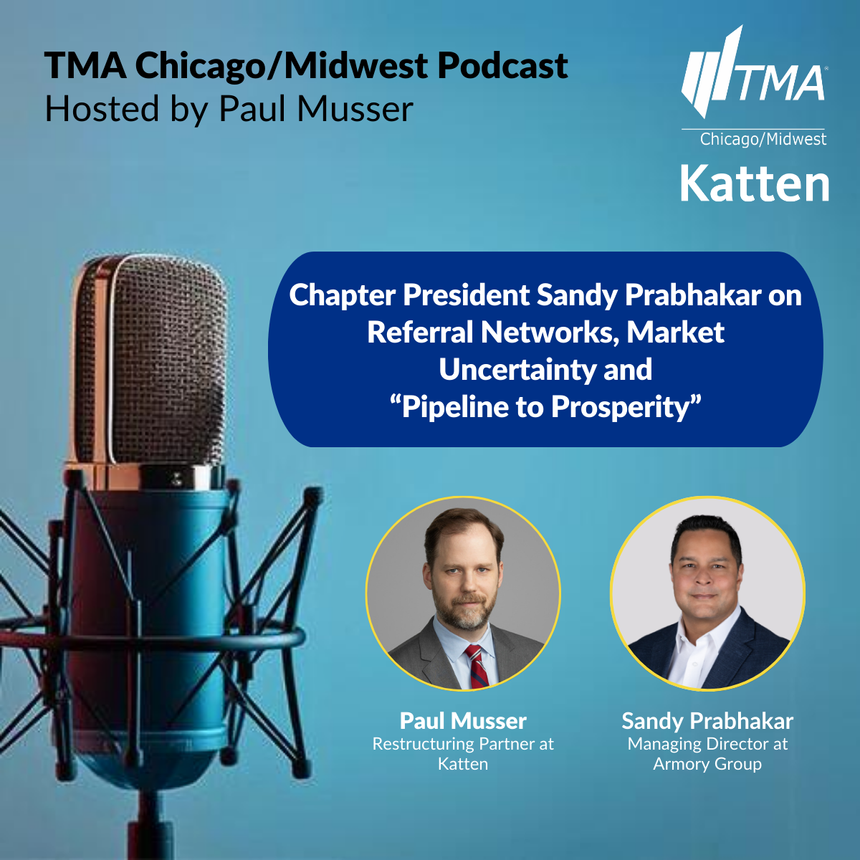
In the first episode of the new year, the TMA Chicago/Midwest Podcast welcomed Sandy Prabhakar, the chapter's 2026 president and Managing Director at Armory Group. Sandy, who has over 20 years of experience advising clients on mergers and acquisitions, refinancings and restructurings, returned as the podcast’s first two-time guest to discuss his path to leadership within TMA and the chapter’s theme for the year, “Pipeline to Prosperity,” which will focus on boosting engagement from members and helping them understand the industry’s referral ecosystem. We also delve into current market trends in distressed sales and refinancing, highlighting challenges such as tariff uncertainties, as well as consolidation opportunities, that are shaping today’s restructuring landscape.
Subscribe on Spotify and on Apple Podcasts.
Listen to more episodes of "TMA Chicago/Midwest Podcast Hosted by Paul Musser."
Paul Musser (00:11): In this first episode of the new year, we have with us TMA Chicago/Midwest Chapter President for 2026, Sandy Prabhakar. Sandy is also a Managing Director at Armory. He has over 20 years of experience advising clients on M&A activities, capital raisings, refinancings, restructurings and crisis management.
Sandy represents both private and public clients in negotiating placements of debt and equity, raising private equity, and fulfilling both sell-side and buy-side M&A mandates for both out-of and in-court situations. He is also the first two-time guest on our podcast. Welcome again to the podcast, Sandy. Thanks for joining me today.
Sandy Prabhakar (00:53): Thanks very much, Paul. Appreciate you having me again.
Paul (00:56): I wanted to start off talking to you about your TMA path to becoming the Chicago/Midwest Chapter President. Can you describe your TMA journey?
Sandy (01:07): Certainly. Well, I've been blessed to be a TMA member now for over 20 years. I had just joined the Deloitte's restructuring practice here in Chicago. So, that was in January of 2005, which is when I became a member. I remember walking into my very first TMA meeting, feeling out of my element. Back then, I saw a bunch of people who were a lot older than me in suits, very professional and having very, very in-depth conversations. It was one of the first breakfast events that I went to, and I was feeling somewhat intimidated.
What I can say is that starting back in 2005, and then just as a member year over year … coming to more events, meeting people, learning what they did, and then eventually, most importantly, getting involved … When I first began my journey as a part of the leadership team, it started really with the golf outing, just helping plan the golf outing and then moving to different roles in communication and other programming. And then eventually, I became treasurer for a two-year term. And that led, frankly, to them approaching me and saying, would I have an interest in taking on the presidency? I was honored to be asked and was able to have a conversation with my firm to make sure they were supportive as well. Very fortunately, they were so supportive. They became a platinum sponsor this year.
So, you know, truly honored for the opportunity to do it and can honestly say that I've built an amazing network of people not just in the Midwest, but nationally, through TMA. And it's been a wonderful addition to my career and my current networking efforts outside of the TMA, as well as in my industry.
Paul (02:50): So, what advice would you give to people wanting to maximize their membership like you have over the course of your journey?
Sandy (02:57): Yeah, I would absolutely say get involved sooner. What I've learned about the TMA is that it's an amazing group of individuals who cover eight to nine different professions. Something that I've focused a lot on this year, as my theme, is to ensure that people are connecting, making connections, understanding what value propositions they're offering to the people in the TMA, their fellow members and sponsors, and most importantly, how they can help them in searching for opportunities that benefit them, which effectively returns the same favor back when people understand what you do as an individual and how they can help you build your business. And I think that's really the benefit of membership and sponsorship for the TMA.
Paul (03:42): And then, what advice would you give to younger restructuring professionals as they begin their journey? I often thought, when I was starting out, that being a member in professional organizations was sort of like a nice entry into the profession and getting to know people. But how can they maximize that process and the benefits that go with organizations like TMA?
Sandy (04:03): Yeah, great question. And what I tell a lot of my younger colleagues who are just starting out in the industry is, first and foremost, don't forget where you came from. You know, make sure you are still connected with your personal networks, your classmates from school, your fraternity brothers and sisters, right? Really maintain those relationships because what happens is, and it's a funny thing when it happens, is as you continue on, you maintain contacts with the people that you work with, even your junior colleagues from your first firm. Everyone tends to just branch out and go into different areas. Sometimes they stay in restructuring, sometimes they stay tangential to it, sometimes they go into corporate. But those are all sources of potential opportunities for you as you maintain those relationships. And everyone rises in their profession with their experience levels and eventually get to a point where they become a decision maker.
And that's really what I can say has happened to me. I've been in Chicago 25 years now, exactly. And a lot of my earlier friends and colleagues have now become great referral sources to me. And I think only because I really worked hard at maintaining that network and ensuring that I was constantly touching people and going out to events and making sure that I understood how I could help them, and in return, how they could help me. It takes work, and it takes effort, but it is a labor of love.
Paul (05:25): Yeah, it really is, and it's especially gratifying when you enjoy spending time with those people and you can share in their successes as they move forward in their career, just like you are. It really is a slow burn, or planting seeds, or whatever the analogy is, right? That it takes time, too. It's nothing that's going to happen overnight. But, the process is rewarding at the end of the day.
You mentioned before — the chapter theme for this year. There is this tradition of a chapter theme. Why do you think that's been the case? And what's the purpose of having a chapter theme?
Sandy (06:01): Well, I think if you look back at the history of the TMA in the Midwest chapter I'm speaking for … of course, every president has their own key areas of focus that's based upon where they think the chapter and the industry are going … but also, what helps the members the most for the coming year. And so, from my perspective, the reason I chose “Pipeline to Prosperity” is because I think that a lot of people in the TMA know the two to three major core occupations that make up the TMA. But I think what we often forget is there's actually about seven, eight, almost nine different key occupations around that people do refer business back and forth. A big part of my focus is to ensure people get a return on their investment because at the end of the day, membership costs money and sponsorship costs money.
And firms that do this and support people who are members, and bringing sponsorships to the table that allow us to do all the great programming that we do, including things like your podcast, allow us the ability to ensure that we're giving them the opportunity to get a return on that investment, which obviously benefits everybody. Somebody gets a referral that turns into a potential engagement, that turns into a fee. At the end of the day, that covers those investments that are being made, gaining those new opportunities. So, I think that is really why I'm focused a lot on that.
I think the TMA is also doing an amazing job with programming, with continuing education and with networking events. But I really want to bring focus as to why we're all doing this and why we're all here and what's most important first and foremost, especially given where the market is.
Paul (07:42): So, let's talk then about some of the events and the initiatives for this coming year. What are some of your goals, essentially, for the chapter throughout the course of the year, and how are they reflective in the events and initiatives that you see coming up?
Sandy (07:57): Yeah, so one of my goals is to outline clearer vision of the ecosystem of the referral network within TMA. So I'm working on something right now with the program and the administrative team to outline a pictorial version of that and then eventually a matrix version with qualitative information that really shares how, let's say, for example, as a distressed investment banker, who do I refer business to and who refers me business back and why, right?
And that's what I'm trying to get down to a granular level to really allow people to have that vision, because I think oftentimes, when people go to a networking event, they go with the idea that, “Okay, I'm going to go meet some people and hopefully, I can get a referral and get my name out there.” But it really comes down to who's in the room. And something that David Levy and I talked a lot about last year — he was past president — and he did an amazing job at articulating it as well, is that people need to be more focused on who's in the room and who they can talk to from a referral perspective, and who they can provide referrals to. I think that really, really drives a lot of how the TMA is successful in building membership, in gaining sponsorships and just building our brand collectively.
Paul (09:10): I think for me, one of the things that I like the most about TMA are the wide variety of professionals that you end up meeting and working with over the course of the year through different events and what have you. And it really helps you to change your focus from sometimes, you know, doing the work to winning the work. And I think the way that you've talked about it with the “pipeline” and thinking about who's in the room — it really speaks to that idea of how to think better about winning the work and strategizing the different folks that you're going to meet and understanding the role that they play in the ecosystem. Then, trying to think about — “How can I be helpful to them?” — in the hopes that they are going to then be helpful to you in the long run.
Sandy (09:54): That's right. Fundamentally speaking, and as we all know, when we get to a certain level of business and a certain level in our careers, people want to deal with those that they like and they trust and know. And a big part of that familiarity is someone being able to pick up the phone or picking up a call from someone and saying, “Hey, I got something. I just want to run it by you.” Right? And having that rapport, that familiarity over sometimes years, really helps build those opportunities. You'll always get a call from somebody who wants to talk to you and knows you, versus a cold call out of the blue saying, “I saw your name on a directory and wanted to ask you a question.”
Paul (10:29): Yeah, no, I completely agree. I also think that in a lot of ways, it's a good opportunity to work with people before you actually work with people. So, you're working with them like on a committee or helping to put together an event … you know, those things are important, but the stakes are maybe slightly less than if you're doing some large-scale restructuring and working with them that way. You give them a little taste of what it's like, hopefully, to see your good works in a paying engagement of some kind.
Sandy (10:58): That's right.
Paul (10:59): So, in addition to, obviously, your work at TMA, you're heavily involved in the restructuring community. You're on the front lines. Everybody always likes to kind of take stock at the beginning of the year and try to predict what they think is going to happen. In this case, for 2026, what are you seeing in the distressed sale and refinancing markets right now?
Sandy (11:19): What we've definitely seen over the last, say, 18 to 24 months, is a change in appetite when it comes to more challenging deals. And from a refinancing perspective, what we've definitely seen are tighter credit standards in private credit markets versus the retail e-bank markets. And what that means is that deals that you could have done on a more distressed level, say, 36 to 48 months ago, were generally a little easier to get done … a little more flexibility, a little more aggressiveness on lending standards, sometimes going a bit longer into the collateral positions. What we've seen, certainly, in the last 24 months and definitely in the last 12 months, is a much tighter version of those standards.
By doing that, I say it's a bit of a contraction from the flexibility you had in certain credit facilities in today's market versus 24 months ago. And that, in and of itself obviously, causes a little bit of a different dynamic from a refinancing perspective. It makes it more difficult to get refinancing done at par, versus at the discount- to face-value in a troubled refinancing. And we've also seen a tightening in the acquisition markets, also in the same vein, because we think that there are various macro impacts that are happening across a number of sectors. So, as a perfect example, a situation where you have a company that's manufacturing in the United States … however, you've got components coming in from non-US domiciles that are tariff-impacted on the supply chain. Or you have customers who are also impacted by the tariffs of your product, if you're exporting.
These have all caused a great deal of uncertainty in a lot of transactional dynamics. So, diligence is taking sell sides, and you are seeing a lot more what-if analysis when it comes to the impact of potential tariffs. And then, couple that with the financing of those transactions for the buyers — they get impacted by the credit standards, as I mentioned earlier. So, it's definitely a more challenging market. I think as a result, you're going to see a lot more distressed transactions because you're not going to have a lot of choices, especially when things like liquidity do get tight, and you have operational challenges coupled with that. There's not a lot of cans being kicked down the road, if you will, with additional capital involved.
Paul (13:43): Yeah, I represent a lot of lenders and a lot of fiduciaries. And what I've noticed is the same thing, which is that the exit out of deals has become a lot more difficult. People are being faced with much tougher decisions, having to consider discounts, where if you had gone back two or three years, that really wasn't a consideration, and the refinancing market was so good that even the time that you spent out in forbearance or in a workout was much less, and people were able to sell paper and refinance close to par. And now, the environment is very, very different, I would say.
And the deals that I've seen, at least when they get to work out, seem to be in worse shape, too. So that liquidity runway seems to be less, and your options then at the end of it seem to be much tougher. So, people are having to make much more difficult decisions.
What would you see as the opportunities given the market that we're in? Are there opportunities for people to have like right now or on the horizon given the economic situation that we find ourselves in?
Sandy (14:48): I think that when you see stories like this happen in the economy, you do see opportunities for consolidation across a number of sectors. Our firm is very active right now, I know, in the food, beverage and agricultural spaces. There's been a lot of consolidation, especially around the beer industry, because of a lot of the overbuilt nature of what happened in the last seven years from the microbrews popping up. So, there's a lot of consolidation happening in that space — in hard liquor, we're seeing a lot of consolidation in that space as well, because of the changing drinking habits of Americans.
I think that you're definitely seeing a lot of distress in the transportation space, commercial transportation especially. think we've all seen our share of large transport companies these last 12 months that have gone into chapter 11 — some go straight into liquidation. There's been a lot of excess capacity within the industry for the last few years. And I think now, with the reduction in imports, when you're not having goods being transported across country, I think that you are definitely seeing excess capacity there as well. So, that is an opportunity for consolidation without question. I think you're going to continue to see more industries play out like that.
Automotive was pretty quiet for a number of years, but now with the drop off of the EV tax credits, the reduction in sales of these EVs is now impacting a lot of the supply chain who kind of planned for a larger volume of growth within those. So, those are now going to be put on hold. You're going to see consolidation in some of those supply chains as well, for the automotive sector.
Paul (16:20): Yeah, you would think that it should be a buyer's market at this point. And there has been all this talk about the powder that's been on the sidelines that people have been saving for this type of opportunity, to get distressed assets that have been undervalued. But at the same time, you see these headwinds, just really with a lot of uncertainty. And my sense is that that's going to be the thing that people have to really wrap their minds around, right? Which is … do they feel comfortable investing significant dollars when they aren't sure if they really can predict what the future holds? I think that'll be like the conglomeration of issues that buyers, who otherwise maybe could make up pretty well on some of these situations, are going to have to sort out for themselves.
Sandy (17:07): Agree that stability drives growth and predictability. And when you don't have those factors to rely on or to bet on, if you will, I think that does cause a lot more caution and a lot more patience with people. And there's a lot of dry powder out there without question. It's just that people are being very opportunistic in how they're deploying it, especially in the special situations world.
Paul (17:28): So, what do you see as the rest of the year? Do you think it's going to be more of the same — the current environment — or do you think things are going to be improving in general or moving in the opposite direction? I've seen a lot of different forecasts as far as trying to predict if there's going to be a recession, but what do you think might be happening over the course of this year?
Sandy (17:52): I mean, from my feeling — unless you can have stability come back into the market and you can remove a lot of the tariff threats — I think only then, you get stability. I don't know how we're going to stabilize, per se. And I'm not quite sure how inflation will abate materially in the next six to 12 months. Obviously, there's a number of headwinds. I know some people heard this last week at the TMA Economic Forum that we held, where they really talked a lot about the impact of inflationary effects on food, as well as household costs, mortgages and rent. So, these fundamentally are areas that have to at least stabilize and begin to normalize before I think the economy can say it's actually on the right track again. I do think you're going to see a lot more bankruptcies this year across a number of the sectors we talked about, because you're not going to have that dearth of extra capital to “bail out businesses and buy them more time,” because you're not going to have consumer demand. That drives the problems.
Paul (18:53): Yeah, those areas that you were talking about, they're really just meat and potato issues that are going to affect everybody. And that “come first, before you hit the discretionary spending” … that seems to have uplifted the economy for the last couple of years. So, it will definitely be interesting, that's for sure, especially for folks in the restructuring space.
What I consistently hear, from at least the lender side, is to expect things to get busier for their special assets folks and for the people like myself and you that are assisting them in trying to get the best recovery that they possibly can for their distressed assets.
Sandy (19:32): Yeah, agreed. Absolutely agreed.
Paul (19:35): Well, thanks so much for joining me on the podcast today, Sandy.
Sandy (19:39): Thanks for having me, Paul. I very much appreciate it. It's always great talking to you.
Paul (19:35): It's been my pleasure. Our guest today was Sandy Prabhakar from Armory, who is also the TMA Chicago/Midwest chapter’s president for 2026. Thank you, listeners, for tuning in. I'm Paul Musser, and this has been an episode of the TMA Chicago Midwest Podcast.
/Passle/5fb3c068e5416a1144288bf8/MediaLibrary/Images/2026-10-06-20-06-22-572-6ac554be4e3377a132b4bb3f.png)
/Passle/5fb3c068e5416a1144288bf8/SearchServiceImages/2026-10-01-11-31-16-673-6abe4484864f593e513405f6.jpg)
/Passle/5fb3c068e5416a1144288bf8/SearchServiceImages/2026-09-29-15-42-41-732-6abbdc71460fb9469a258b9e.jpg)
/Passle/5fb3c068e5416a1144288bf8/SearchServiceImages/2026-09-28-14-41-14-052-6aba7c8a266cd4c9ede726a8.jpg)